

Ship Oil Pollution Emergency Plan
| Yacht Name | Shipyard | ||
| Flag | Port of Registry | ||
| Revision | 1.0 | Date of issue | 31 Mar 2026 |
| MMSI | 9937505 | Call Sign | 9HA6465 |
| Gross Tonnage | 499GT | Date of Keel Laying | 13th February 2020 |
| Company | Yachting Concept Monaco | Office Number | +377 99 90 16 30 |
| Director | Thierry Roux | ||
| Designated Person | Christophe Guegan | 24/7 Phone | +377 99 92 36 48 |
| Company approval | RO approval | ||
| Date | Date |
The SOPEP plan is mandatory for all yacht above 400GT and provides the onboard procedures, responsibilities, and immediate contact information required to respond effectively to an oil pollution incident.
The SOPEP plan is usually originally provided by the ship builder and is specifically designed during the construction of the yacht. In the event of a major refit, or if the yacht has lost its SOPEP onboard, Yachting Concept Monaco will coordinate to create a dedicated plan to the specific yacht.
Regulation 37 of MARPOL Annex I requires that all yacht of 400 gross tonnage and above carry an approved Shipboard Oil Pollution Emergency Plan (SOPEP).
1. Emergency Contact Data
| Contact | Details |
|---|---|
| Shoreside Response Coordinator | Yachting Concept Monaco 36 rue Grimaldi - MC 98000 Monaco |
| Office phone: | + 377 99 90 16 30 |
| e-mail: | dpa@yachtingconcept.com |
| Mobile phone | +377 99 92 36 48 (24/7) |
| Technical Advisor | Yachting Concept Monaco 36 rue Grimaldi - MC 98000 Monaco |
| e-mail: | dpa@yachtingconcept.com |
| Mobile phone | +377 99 92 36 48 (24/7) |
2. General Policy
This Plan is written in accordance with the requirements of Regulation 37 of Annex I of the International Convention for the Prevention of Pollution from Ships, 1973, as modified by the Protocol of 1978 relating thereto. The purpose of the Plan is to provide guidance to the master and officers on board the ship with respect to the steps to be taken when a pollution incident has occurred or is likely to occur.
The Plan contains all information and operational instructions required by the Guidelines issued by the International Maritime Organization (IMO). The Appendices contain names, telephone, telefax and telex numbers of all contacts referenced in the plan, as well as other reference material.
This Plan has been approved by RINA on behalf of the Administration and, except as provided below, no alteration or revision shall be made to any part of it without the prior approval of RINA.
Changes to Section 5 and the Appendices will not be required to be approved by the Administration
3. Preamble
This Plan is available to assist personnel in dealing with an unexpected discharge of oil. Its primary purpose is to set in motion the necessary actions to stop or minimize the discharge and to mitigate its effects. It includes guidance to assist the master in meeting the demands of both an operational spill and a catastrophic discharge, should the ship become involved in one. Effective planning ensures that the necessary actions are taken in a structured, logical, safe and timely manner.
The Plan goes beyond providing for operational spills. The need for a predetermined and properly structured Plan is clear when one considers the pressures and multiple tasks facing personnel confronted with an emergency In the heat of the moment, lack of planning will often result in confusion, mistakes and failure to advise key people. Delays will be incurred and time will be wasted; time during which the situation may well worsen. Therefore, the ship and its personnel may be exposed to increasing hazards and greater environmental damage may occur.
For the Plan to accomplish its purpose, it must be:
- realistic, practical and easy to use;
- understood by ship management personnel, both on board and ashore;
- evaluated, reviewed and updated regularly.
The Plan envisioned by Regulation 37 of Annex I to the Convention is intended to be a simple document. Use of summarising flow charts or checklists to guide the master through the various actions and decisions required during an incident response is highly encouraged. These can provide a quickly visible and logically sequenced form of information which can reduce error and oversight during emergency situations. Inclusion of extensive background information on the ship, cargo, etc., should be avoided as this is generally available elsewhere. If such information is relevant, it should be kept to annexes where it will not dilute the ability of ship’s personnel to locate operative parts of the Plan.
The Plan is likely to be a document used on board by the master and officers of the ship. It must therefore be available in a working language or languages understood by the Master and officers. A change in the Master and Officers which brings about an attendant change in their working language or languages understood would require the issuance of the Plan in the new languages.
This Plan consists of:
- the list of authorities or persons to be contacted in the event of an oil pollution incident (see Section 4);
- the procedure to be followed by the master of other persons having charge of the ship to report an oil pollution incident (see Section 2);
- a detailed description of the action to be taken immediately by persons on board after a spill has occurred (see Section 5);
- the procedures and point of contact on the ship for co-ordinating shipboard activities with national and local authorities in combating the pollution (see Section 6).
4. Reporting requirements
4.1. When to report
This section provides guidance to enable the master to determine when a report to the Coastal State and to those individuals/organisations specified in Section 4.3 is required. To expedite response and minimize damage from a pollution incident, it is essential that appropriate Coastal States should be notified without delay . Without interfering with shipowners’ liability, some Coastal States consider that it is their responsibility to define techniques and means to be taken against an oil pollution incident and approve such operations which might cause further pollution, i.e. lightening.
States are in general entitled to so under the International Convention relating to intervention on the High Seas in Cases of Oil Pollution Casualties, 1969 (Intervention Convention). Other coastal States, in general different from the ones that signed the Intervention Convention, require ships to have contracts with “response contractors” when ships enter into such States’ ports. It is therefore recommended that, when the ship sails toward such States, response resources (personnel and equipment) and capabilities are identified in advance for each potential State’s port.
Actual discharge
A report to the Coastal State and to those individuals/organisations specified in Section 4.3 is required whenever there is:
- a discharge of oil above the permitted level for whatever reason, including those for the purpose of securing the safety of the ship or saving life at sea; or
- a discharge during the operation of the ship of oil in excess of the quantity or instantaneous rate permitted under the present MARPOL Convention.
Probable discharge
A report to the Coastal State and to those individuals/organisations specified in Section 4.3, may be required if there is a situation which, though not involving an actual discharge, would qualify as a substantial threat of a discharge. In judging whether there is such a probability and whether the report should be made, the following factors, as a minimum, should be taken into account:
- the nature of the damage;
- ship location and proximity to land or other navigational hazards;
- weather, tide, current and sea state; and
- traffic density.
As a general guideline, the master should report in cases of:
- damage, failure or breakdown which affects the safety of ships; examples of such situations are collision, grounding, explosion, structural failure, flooding, cargo shifting, etc.; and
- failure or breakdown of machinery or equipment which results in the impairment of the safety of navigation; examples of such incidents are failure or breakdown of steering gear, propulsion, electrical generating system, essential shipborne navigational aids, etc.
4.2. Required information
In case of an actual discharge or a probable discharge which requires a report according to the provisions of Section 4.1.2, Format 1 “Initial notification” shall be sent to the Coastal State and the individuals/organisations of Section 4.3 according to the notification flowchart of Section 4.3.4.
In case of an actual discharge which requires information be provided according to the provisions of Section 4.3.2 so that damage stability and damaged longitudinal strength assessment may be made , Format 2 “Stability and strength assessment notification” shall be sent to the Technical Advisor of the Owner according to the notification flowchart of Section 4.3.4.
The initial notification shall be followed by supplementary and/or follow-up reports according to Format 3
4.3. Whom to contact
The ship involved in an actual discharge or a probable discharge which requires a report according to the provisions of Section 4.1.2 shall have to communicate with both Coastal State (or port contacts if the ship is in port) and ship interests contacts according to the notification flowchart given in Section 4.3.4.
Coastal State contacts
In Appendix 1 of this Plan the list of agencies or officials of administrations responsible for receiving and processing reports and updated by the Organization is given. Should any undue delay be experienced in contacting the responsible authority by direct means, the master shall contact the nearest coastal radio station, designated ship movement reporting station or rescue co-ordination centre (RCC) by the quickest available means.
Port contacts
For ships in port, local agencies shall be notified according to Section 4.3.4. Information on regularly visited ports is included in Appendix 2 to this Plan. When the next port of call is a port which is not included in the list, the Master shall obtain details concerning its local reporting procedure before departure and update Appendix 2 accordingly.
Ship interests contacts
The complete list of all parties with an interest in the ship who are to be notified according to Section 4.3.4, is given in Appendix 3. The contacts of the Shoreside Spill Response Coordinator and of the Technical Advisor are reported on page 3. The list shall be updated when necessary.
Notification flowchart
| Priority | Who | Action | Format | Who to inform | Where in the Plan |
|---|---|---|---|---|---|
| 1 | Master | Send the Initial notification | 1 | Coastal State (ship at sea) | Appendix 1 |
| 1 | Port contact (ship in port) | Appendix 2 | |||
| 1 | Operator (Qualified Individual) | Page 3 | |||
| 1 | Technical Advisor | Page 3 | |||
| 2 | Master | Send the stability and strength assessment notification | 2 | Technical Advisor | Page 3 |
| 3 | Master | Send follow-up notifications | 3 | Coastal State (ship at sea) | Appendix 1 |
| or port contact (ship in port) | Appendix 2 | ||||
| Operator (Qualified Individual) | Page 3 | ||||
| Technical Advisor | Page 3 | ||||
| 4 | Operator | Send the Initial notification | 1 | Owner | Appendix 3 |
| 5 | Owner | Activate clean-up resources (if necessary) | 1 | Oil Spill Removal Organization | |
| 6 | Owner | Send the Initial notification | 1 | Cargo Owner (n/a) | If there is a cargo owner (n/a) |
| 7 | Owner | Send the Initial notification | 1 | Insurer representative | |
| 8 | Owner | Send the Initial notification | 1 | P&I Club representative | |
| 9 | Owner | Send the follow-up notifications | 3 | Oil Spill Removal Organization | |
| Insurer representative | |||||
| P&I Club representative |
Shore Side Spill Response Coordinator
The “Shore side Spill Response Coordinator” or “Qualified Individual” is a shore based person of the Owner/ Operator or appointed by the Owner/ Operator to be a guidance for the Master for requesting and coordinating initial response personnel and equipment. For this ship the Shore Side Spill Response Coordinator Yachting Concept Monaco. 36 rue Grimaldi - MC 98000 Monaco. See Page 3 for details
4.4. Communication methods
In case of actual discharge or a probable discharge which requires a report according to the provisions of Section 4.1.2, the primary communication method (see Table 4.1) shall be used.
In case notification by the primary communication method is not available on board, fails or should any undue delay be experienced, then a secondary communication method with the priority indicated in Table 4.1 shall be used.
In case both primary and secondary communication methods fail, then emergency notification method shall be used.
In case of an actual discharge which requires information be provided to the Technical Advisor, then notification by primary communication method shall be preceded by a verbal communication via SATCOM phone.
| COMMUNICATION METHOD | PRIORITY | DETAILS |
|---|---|---|
| Primary | 1 | Written report transmitted by fax over the vessel’s Satellite Communication (SATCOM) |
| Secondary | 2 | Verbal communication via SATCOM phone |
| 3 | WhatsApp (or equivalent) via SATCOM | |
| Emergency | 4 | Verbal report via HF or VHF coast radio station |
Table 4.1
5. Steps to control discharge
Ship's personnel will almost always be in the best position to take quick action to mitigate or control the discharge of oil from the ship.
In this Section guidance is given to the Master on how to accomplish operational spills and spills resulting from casualties. Actions to be taken by onboard personnel for each spill scenario are outlined in checklists at the end of this Section, according to the following Table 5.0.
Table 5.0
5.1 On-board response team
An on-board response team shall be established according to the following Fig. 5.1 to take quick action to mitigate or control a discharge.
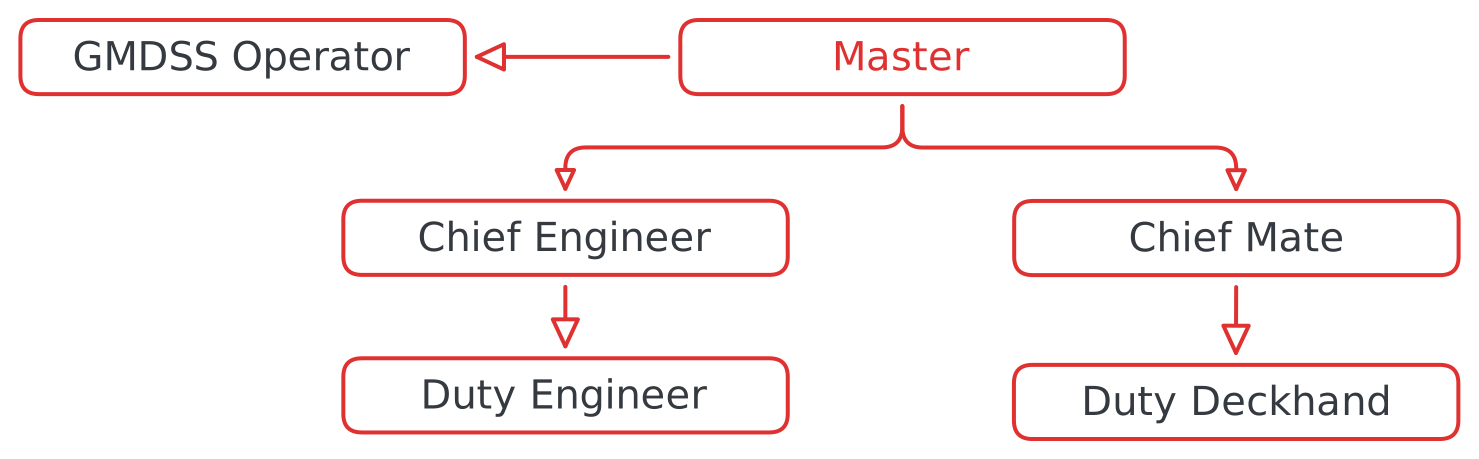
5.2 Operational spills
Actions to be taken by and duties and responsibilities of onboard personnel for safe removal of oil spilled and contained on deck in case of pipe leakage, tank overflow and hull leakage are outlined in Checklists number 1, 2 and 3 respectively. In addition to the checklists and personnel duty assignment, the Plan provides the Master with guidance concerning priority actions, stability and stress considerations, lightening and mitigating activities.
5.3 Spill resulting from casualties
5.3.1 Priority actions
In responding to a casualty, the master’s priority will be to ensure the safety of personnel and the ship and to take action to prevent escalation of the incident. In casualties involving spills, immediate consideration should be given to measures aiming at preventing fire, personnel exposure to toxic vapours and explosion, such as altering course so that the ship is upwind of the spilled oil, shutting down non-essential air intakes, etc. If the ship is aground, and cannot therefore manoeuvre, all possible sources of ignition should be eliminated and actions taken to prevent toxic vapours or flammable vapours entering accommodation and engine-room spaces. When it is possible to manoeuvre, the master, in conjunction with the appropriate shore authorities, may consider moving his ship to a more suitable location, in order, for example, to facilitate emergency repair work or lightering operations, or to reduce the threat posed to any particularly sensitive shoreline areas. Such manoeuvring may be subject to Coastal State jurisdiction.
Prior to considering remedial action, the Master will need to obtain detailed information on the damage sustained by his ship. A visual inspection should be carried out and all bunker tanks and other compartments should be sounded. Due regard should be paid to the indiscriminate opening of ullage plugs or sighting ports, especially when the ship is aground, or loss of buoyancy could result.
Having assessed the damage sustained by the ship, the master will be in a position to decide what action should be taken to prevent or minimize further spillage. When bottom damage is sustained, hydrostatic balance will be achieved fairly rapidly especially if the damage is severe, in which case the time available for preventive action will often be limited. When significant side damage is sustained in the way of oil tanks, oil or bunkers will be released fairly rapidly until hydrostatic balance is achieved and the rate of release will reduce and be governed by the rate at which oil is displaced by water flowing in under the oil. When the damage is fairly limited and restricted, for example, to one or two compartments, consideration may be given to transferring oil internally from damaged to intact tanks.
5.3.2 Stability and stress considerations
Great care in casualty response must be taken to consider stability and strength when taking actions to mitigate the spillage of oil or to free the ship if aground.
Internal transfers should be undertaken only with a full appreciation of the likely impact on the ship’s overall longitudinal strength and stability.
The Master shall duly compile and send Format 2 “Stability and strength assessment notification ” (see Section 2) so that damage stability and damaged longitudinal strength assessment may be made by the Technical Advisor in the following cases:
- an actual discharge resulting from a casualty
- a probable discharge which requires a report to the Coastal State according to the provisions of Section 2.1.2.
Format 2 shall be sent to the Technical Advisor according to the notification flow chart given in Section 2.3.4 .
5.3.3 Technical Advisor
For this ship the technical organisation in charge for the damage stability and longitudinal stress assessment is Yachting Concept Monaco (relevant contacts are given on Page 3).
5.3.4 Lightening
Should the ship sustain extensive structural damage, then it may be necessary to transfer all or part of the cargo to another ship. Any ship-to-ship transfer of bunkers shall be carried out, as far as applicable, in compliance with the “Ship to Ship Transfer Guide (Petroleum)” issued jointly by the International Chamber of Shipping and the Oil Companies International Marine Forum, to be taken enclosed to this Plan, and also taking into consideration the right of Coastal States to approve such operation, which is a potential cause of further pollution (see section 2.1).
5.3.5 Mitigating activities
When the safety of both the ship and personnel has been addressed, the Master can initiate mitigating activities according to the guidance given by the Plan, addressing such aspects as:
- assessment and monitoring requirements;
- personnel protection issues:
- protective equipment; and
- threats to health and safety
- containment and other response techniques (e.g. dispersing, absorbing, etc.)
- isolation procedures;
- decontamination of personnel; and
- disposal of removed oil and clean-up materials.
5.3.6 Plans and drawings
In order to allow damage stability and damaged longitudinal strength assessment be made by the Technical Advisor, the following plans and drawings shall be available at the Technical Advisor’s office:
- Lines and body plan
- General arrangement plan
- Capacity plan
- Hydrostatic curves of form
- Cross curves of stability
- Midship sections and typical transversal sections
- Construction profiles and deck plans
- Shell expansion
- Transverse bulkheads
- Vent overflows
- Bilge and ballast piping
- Lightship weight vertical centre of gravity
- Gaugings
- Ballast and bilge pump curves
- Loading manual
- Trim and stability booklet
- Tanks ullage tables with any ship’s heeling and trimming
- Loadline marks position relevant to the perpendiculars.
5.4 Checklists
- Bunkering Preparation
- Bunkering Operation
- Oil Spill
- Tank Overflow
- Suspected Hull Leakage
- Collision
- Grounding/Stranding
- Flooding
- Containment System Failure
- Submerged/Foundered
- Wrecked/Stranded
6. National and local co-ordination
Quick and efficient co-ordination between the ship and other Coastal State or other involved parties becomes vital in mitigating the effects of a pollution incident.
After immediate actions to control discharge and minimize the escape of oil have been taken by the on-board personnel (see Section 3), the intervention of on-shore resources to combat the spill may be necessary.
As a general rule, Coastal State shall be contacted for authorization prior undertaking mitigation action. However, the identities and roles of various national and local authorities in this respect may vary widely from State to State and even from port to port:
- some Coastal States have agencies that take charge of response immediately and subsequently bill the owner for the cost;
- in other Coastal States, responsibility for mitigating response is placed on the shipowner.
Prior commencing a voyage, the Master shall obtain details concerning the procedures followed by the national and local authorities of the next port of call in case of a pollution incident and shall duly compile the following Format 4, the content of which shall be used in case a spill occurs during that voyage under the jurisdiction of the Coastal State.
7. Additional information
7.1 Plans and diagrams
Plans and diagrams specified in Table 7.1 are appended to the Plan or their location identified.
7.2 Response equipment available on board
In Table 7.2 the Master should report the equipment carried on board to assist in pollution response, together with personnel responsibilities for its deployment, oversight and maintenance. No chemical agent should be used for response to pollution on the sea without authorization of the appropriate Coastal State.
7.3 Record keeping
The Master is responsible for keeping record of events whenever there is an actual discharge or a probable discharge. Apart from detailing all actions taken on board, records shall include communications with outside authorities, owner and other parties, as well as a brief summary of decision and information passed and received. All spilt oil should be sampled, safety permitting. Any oil observed on the water, while the vessel is at anchor or berth, should be sampled if possible. Samples should be properly marked, with date and location, and sealed, and always be made in duplicate. Samples will be most valuable if the sampling is authenticated by someone not part of the crew.
7.4 Plan review
The Plan can only be changed and/or updated with the written authority of the Company’s in-charge person, with the approval of the Administration.
All comments, corrections and suggestions shall be directed to the above-named individual. All users of the Plan have the responsibility of pointing out changes that effect the validity and/or use of the Plan. Any changes or updates shall be accompanied with a new Record of Changes.
Annual review
Annual review of the plan shall be conducted to ensure compliance with current law, regulations and compatibility with vessel operations. Any changes made to the Plan shall be according to Section 7.4.
Event review
Whenever the Plan has been put in use, either for a drill or actual incident, all parties directly involved shall comment on the effectiveness of the Plan and its content. Such comments shall be forwarded to the responsible person named in Section 7.4.
Plan testing
Exercises on a Regular basis shall be carried out to assure that the Plan functions as expected and that the contacts and communications specified are accurate.
8. Apendixes
Apendix 1: Coastal State Contacts
This Appendix should contain the most current edition of the circular MSC-MEPC.6/Circ.........Annex 2, issued by IMO. The present issue can be downloaded and printed from the Internet under the following address:
http://www.imo.org (select 'Circulars/Contact Points' or ‘National Contacts/Contact Points’ on the left hand side of the IMO homepage)
This Appendix contains the most current edition of the circular MSC-MEPC.6/Circ.........Annex 2 issued by IMO. THE CIRCULAR IS ATTACHED TO THE PLAN
Apendix 2: Port Contacts
This Appendix must contain information on frequently visited ports
| Port Name | Port Authority Contact | Phone | Local Response Organization Contact |
|---|---|---|---|
Apendix 3: Ship’s Interest Contacts
| Ship’s Interest Contacts | |
|---|---|
| Owner / Operator | |
| Address | |
| Phone: | |
| E mail: |
| Shoreside Spill Response Co-ordinator |
|---|
| Relevant contacts on page 3 |
| Technical Advisor |
|---|
| Relevant contacts on page 3 |
9. Revision history
| Version | Date | Editor | Revision history |
|---|---|---|---|
| 1.0 | 31 Mar 2026 | Christophe Guegan | Initial Commit |