
Mooring Arrangement Plan
This plan provides detailed instructions and guidelines for the safe and efficient mooring of the vessel.
| Yacht Name | M/Y --- | Shipyard | |
| Flag | Port of Registry | ||
| Revision | 1.0 | Date of issue | 14 Mar 2024 |
| Gross Tonnage | Date of Keel Laying | ||
| Company | Yachting Concept Monaco | Office Number | +377 99 90 16 30 |
| Director | Thierry Roux | ||
| Designated Person | Christophe Guegan | 24/7 Phone | +377 99 92 36 48 |
| Company approval | RO approval | ||
| Date | Date |
1. Importance of safe mooring
Every year, numerous seafarers are injured, or worse, due to failed mooring lines. 95% of personal injury incidents result from mooring line and wire failures, while equipment malfunctions account for only 5%. Moreover, 65% of these rope-related incidents occur during mooring operations.
Incorrectly moored yachts can cause asset damage and environmental harm. A ship breaking loose from its moorings is a scenario all ports fear. However, a safe and well-managed mooring process can not only reduce such incidents but also enhance the efficiency of yacht operations.
For greater safety, improved efficiency, and consequently, a trouble-free for the captain and his deck team, each yacht should implement an onboard mooring plan.
The purpose of these Guidelines, as defined in the IMO Circ. 1620, is to provide recommendations and guidance for maintenance and in-service inspections of mooring equipment including lines and tails, criteria for identifying worn-out lines and tails for removal from service before failure, and criteria for selection of replacement mooring lines and tails.
These Guidelines apply to all ships. Certain provisions are intended for reference by shipboard personnel, and other provisions are intended for Company personnel responsible for selecting and procuring replacement mooring lines.
2. Mooring Plan
A professional mooring plan is based on several rules:
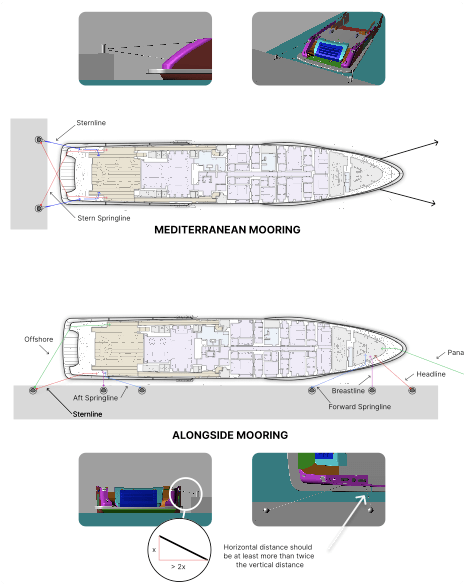
- Vertical angles of spring and breast lines should be a minimum as possible. Ideally the horizontal distance from fairlead to bollard should at least be twice the vertical distance;
- Spring lines should be placed as parallel to the vessel as possible;
- Breast lines should be placed as square to the vessel;
- Mooring lines should work together especially lines in the same function. This is only possible if they've the same elasticity, same length, and same tension;
- Mixed moorings should not be used for the same application;
- Mooring lines should be protected against overload;
- Mooring winches brake should renders well before the minimum breaking load is reached;
- Mooring lines should not overload the bollard ashore even when all lines could be put on one bollard;
- It is still good seamanship to use more than one bollard as a redundancy mooring lines;
- The captain is responsible for safe mooring and he needs to prepare the mooring plan before arrival.
3. Mooring plan execution
3.1. Chain of responsibilities
- Master (On the bridge)
- Chief Mate (Assisting on the bridge)
- Officer (On the aft mooring area)
- Officer or Bosun (On forward mooring area)
3.2. Mooring operations
- Each mooring station should be supervised by an officer in charge;
- The mooring area should be safe both on board and ashore;
- It should be clean anti-slip and properly lit;
- There should be sufficient crew to operate the winches;
- Heaving lines should be prepared so there's a spare line if the first row is not successful;
- All mooring lines should be properly flaked on deck ready to be send ashore;
- Restrict coms on radio to bridge and officers in charge
4. Best practices during adverse conditions
If the yacht is subject of high wind or subject to high swell
- Double the mooring lines on different shore bollard if possible
- Use flexible polyamide mooring lines to dampen the yacht's movement
- Double the fender downwind against other vessel and/or shore side
- Raise the gangway, passerelles higher than usual
- Check regularly protective sleeves position
- If necessary, keep a person on watch 24/7 and organise rotation of the watch keeper
5. How to maintain mooring lines
To avoid damage to the lines and keep them in optimal conditions, you make sure there are no twists or kinks in the lines. Lines and tails they should be stored in a place that protects them from harmful environmental conditions such as uv light water chemicals cargo residues and extreme temperature.
Fairleads regular checks:
- Check roller pedestals and fair leads for smooth operation.
- The rollers should be able to turn when operated manually.
- Grease the bearings accordingly.
- Make sure that the surface of the contact surfaces such as rollers cable guides and blocks is smooth.
- Remove any burrs rust grooves and sharp edges and keep surfaces clean
- Avoid contact and chafing between lines
- In case of prolonged port stays always use protective sleeves in way of overboard fairleads
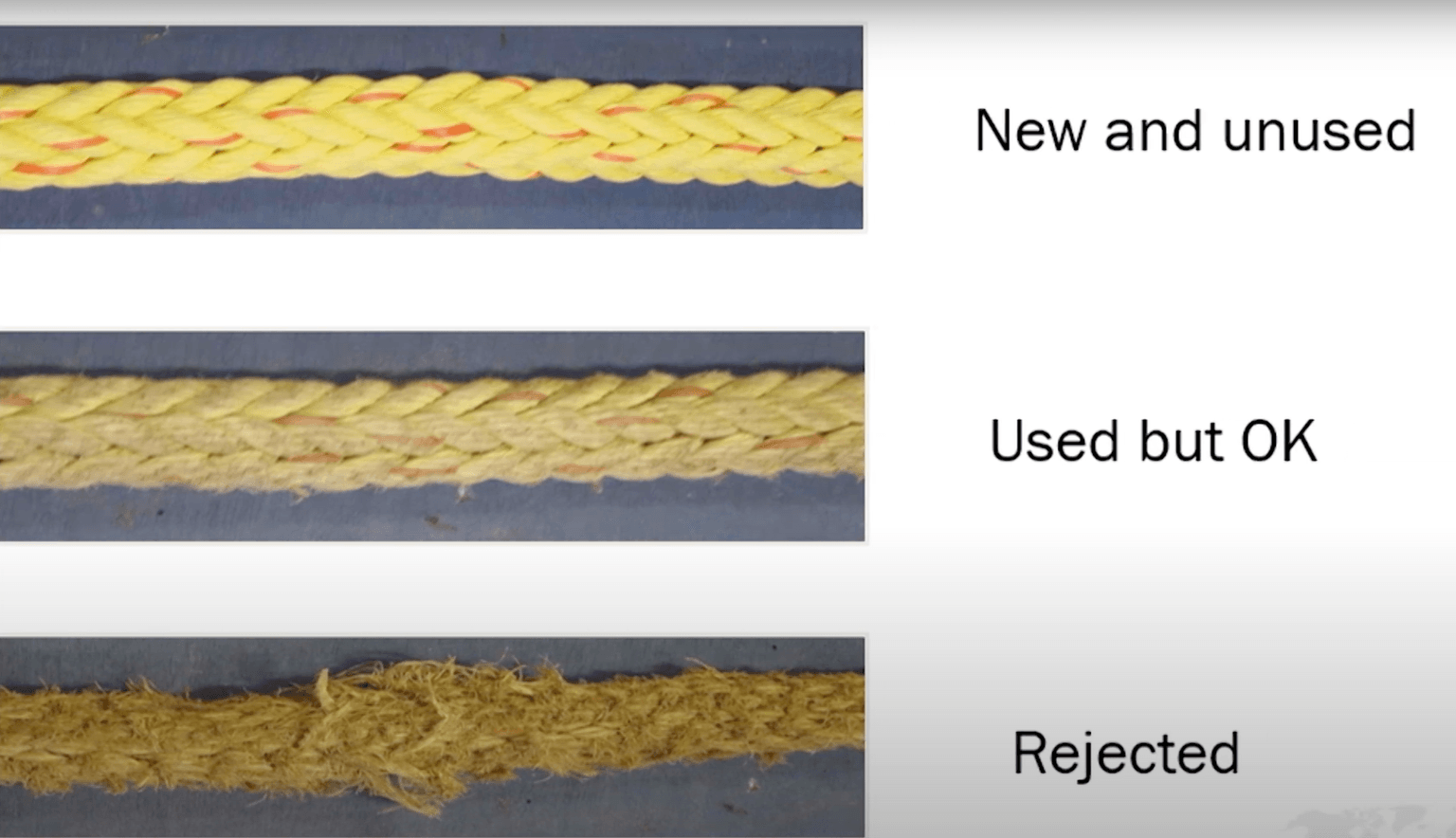
Even if the lines are properly managed, regular visual checks are important to ensure the condition of the rope.
Organise a regular check on the PMS on quarterly basis and log the rate of wear and tear. Rope manufacturers have clear images that can help to rate and which action to take. They can also give proper guidance on how to inspect the lines, how to perform small repairs and give training on how to splice.
6. How to maintain mooring winches
To avoid over stressing the mooring lines, the brake of the mooring winch should always be the weakest component. It's a safety device in the overall configuration which should render before the minimum braking load of the mooring line is reached.
The design criteria for winches on all ships are according to iso the brake holding capacity should be 80% of the minimum braking load of the mooring line. It should be part of the PMS practice to continuously ensure that the winch brake is the weakest link of all the components by testing and adjusting the brake's rendering load. On the other hand it's also obviously important to ensure that the winch brake provides sufficient holding power to keep the yacht close to the pier.
Therefore a winch brake test should be performed regularly and after completion of any maintenance to the winch. In general mooring winches should be maintained in accordance with manufacturer's recommendations and be part of a regular maintenance system. This is assumed to be carried out as part of the owner's obligation towards class. This will also become a requirement from IMO as part of the MSC.1-Circ.1620 guidelines for inspection and maintenance of mooring equipment including lines which will enter into force on the 1st of January 2024.
7. How to select and install new mooring lines and tails
Mooring lines should be selected by engaging with rope manufacturers to ensure the correct lines and tails are selected for the required application on the yacht.
Ensure that the line meets the same elasticity. Ideally all mooring lines have same characteristics but as a minimum, lines in the same service (for example all breast lines) should have the same elasticity. Mixed mooring should not be used at the same application.
If tails need to be ordered ensure that the tail meets the same elasticity of other tails especially tails for the mooring lines in the same service ensure that the tail meets the minimum braking load or line design braking force. All mooring lines should be provided with a certificate that should be kept onboard until the end of its life.
8. Maintenance of machinery mooring equipment
Mooring winches and windlasses have the mechanical strength to pull a line beyond its breaking load. Therefore, it's crucial to calibrate the pull strength to be below the breaking load of the weakest line used at each position.
The electrical engines of winches have brakes that prevent the line from retracting towards the quay, providing a significant safety feature. If the brake fails to operate, the person holding the line could become trapped by the winch.
Annex I: Mimtee Mooring Plan
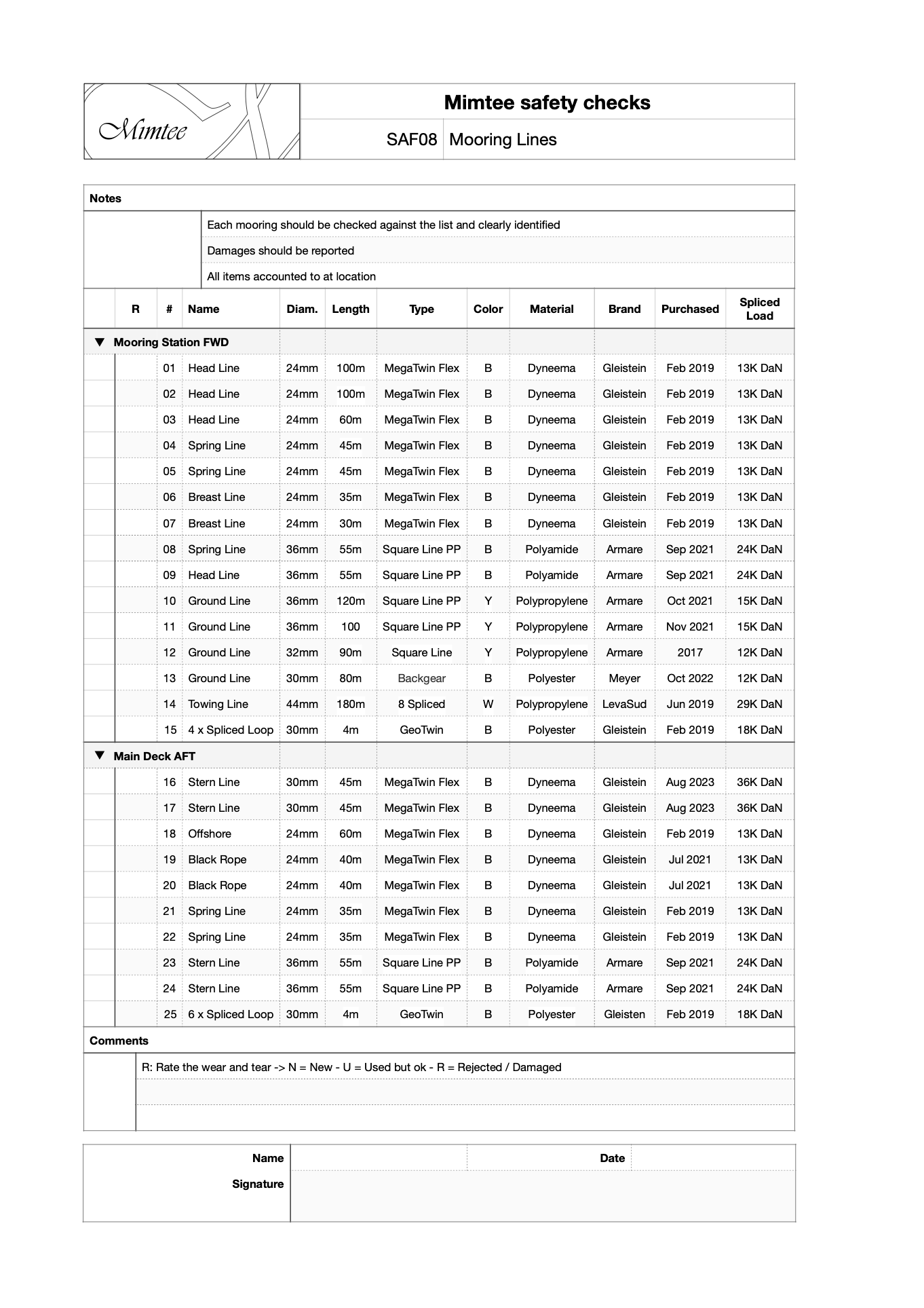
Annex II: Mimtee Mooring List
9. Revision History
| Version | Date | Editor | Revision History |
|---|---|---|---|
| 1.0 | 14 Mar 2024 | Christophe Guegan | Initial Commit |