

Ship Security Plan
The final plan that contains confidential information should be kept at all time in the master safe. This document contains generic plan that is requested to be updated with specific data for each yachts
| Yacht Name | M/Y --- | Shipyard | |
| Flag | Port of Registry | ||
| Revision | 2.1 | Date of issue | 01 Apr 2026 |
| Gross Tonnage | Date of Keel Laying | ||
| Company | Yachting Concept Monaco | Office Number | +377 99 90 16 30 |
| Director | Thierry Roux | ||
| Designated Person | Christophe Guegan | 24/7 Phone | +377 99 92 36 48 |
| Company approval | RO approval | ||
| Date | Date |
Flag Security Data
Marshall Islands
For ALL inquiries about the ISPS Code, piracy, LONOs for Armed Security Personnel (PMSC/PCASP/VPD), Ship Security Advisories, and reporting of security incidents (e.g., stowaways, armed robbery at sea, illegal boarding).
| Office | Details |
|---|---|
| Switzerland’s Office | IRI Corporate & Maritime Services (Switzerland) SA |
| 16, rue de la Pélisserie | |
| CH-1204 Geneva, Switzerland | |
| Tel: +41 22 310 64 54 | |
| Fax: +41 22 310 64 55 | |
| geneva@register-iri.com | |
| Baltimore / Annapolis’s Office | 427 Fourth Street |
| Annapolis, Maryland 21403-2503 | |
| United States of America | |
| Emergency Phone Available 24/7 | For maritime emergencies only |
| Dedicated phone: +1 571 441 1885 | |
| Fax: +1 703 860 2284 | |
| Emergency Email | shipsecurity@register-iri.com |
| Sources of security information | https://www.register-iri.com/maritime/maritime-security/ |
Cayman Islands
For ALL inquiries about the ISPS Code, piracy, LONOs for Armed Security Personnel (PMSC/PCASP/VPD), Ship Security Advisories, and reporting of security incidents (e.g., stowaways, armed robbery at sea, illegal boarding).
| UK Office | |
|---|---|
| Cayman Office | |
| Emergency Phone Available 24/7 | For maritime emergencies only** |
| Dedicated phone | |
| Emergency Email | |
| Sources of security information |
1. Definitions
| Term | Definition |
|---|---|
| ISPS Code | The International Ship and Port Facility Security Code, adopted by the IMO in December 2002 as amendments to SOLAS Chapter XI-2. It establishes an international framework for detecting and deterring security threats to ships and port facilities. |
| CSO | Company Security Officer — the person designated by the company to ensure that a ship security assessment is carried out, that a Ship Security Plan is developed and submitted for approval, and that the plan is thereafter implemented and maintained. |
| SSO | Ship Security Officer — the person on board the ship, accountable to the Master, designated by the company as responsible for the security of the ship, including implementation and maintenance of the Ship Security Plan, and liaison with the CSO and PFSOs. |
| PFSO | Port Facility Security Officer — the person designated as responsible for the development, implementation, revision, and maintenance of the port facility security plan and for liaison with the SSO and CSO. |
| SSP | Ship Security Plan — a plan developed to ensure the application of measures on board the ship designed to protect persons on board, cargo, cargo transport units, ship's stores, or the ship from the risks of a security incident. |
| SSAS | Ship Security Alert System — a system fitted on board the ship that, when activated, transmits a ship-to-shore security alert to a competent authority designated by the flag state, identifying the ship, its location, and indicating that the security of the ship is under threat or has been compromised. |
| DoS | Declaration of Security — an agreement reached between a ship and either a port facility or another ship with which it interfaces, specifying the security measures each will implement. |
| Security Level 1 | Normal — the level for which minimum appropriate protective security measures shall be maintained at all times. |
| Security Level 2 | Heightened — the level for which appropriate additional protective security measures shall be maintained for a period of time as a result of heightened risk of a security incident. |
| Security Level 3 | Exceptional — the level for which further specific protective security measures shall be maintained for a limited period of time when a security incident is probable or imminent, although it may not be possible to identify the specific target. |
| Contracting Government | A government that is party to SOLAS and the ISPS Code and is responsible for setting security levels and communicating security-related information to ships and port facilities within its jurisdiction. |
| Ship/port interface | The interactions that occur when a ship is directly and immediately affected by actions involving the movement of persons, goods, or the provision of port services to or from the ship. |
| Security incident | Any suspicious act or circumstance threatening the security of a ship, including a mobile offshore drilling unit and a high-speed craft, a port facility, or any ship/port interface or ship-to-ship activity. |
2. Introduction
The purpose of this Ship Security Plan (SSP) is to contribute to the prevention of illegal acts against the ship, its crew, and passengers. It has been prepared under Chapter XI-2 of SOLAS and the International Ship and Port Security Code
Authorised copies of this SSP must be controlled so all authorized holders of the plan have the current revision.
2.1. Responsibilities
| Position | Responsibility |
|---|---|
| Ship Security Officer (SSO) | for proposing revisions to this plan |
| Captain | to confirm the proposal |
| Company Security Officer (CSO) | to ensure accuracy of information and details within the plan. |
2.2. Detail
No alteration or revision shall be made to any part of the SSP without the prior approval of the flag authority, or by the administration approved and designated by the flag authority. Such a statement will be contained in the Letter of Approval.
2.3. Periodic Review Procedures
- This plan must be reviewed annually based in part on the results of the annual security assessment performed or organised by the Company Security Officer.
- If revisions are required, they will be drafted by the SSO for review and approval as specified above.
2.4. Plan Security and control
- Distribution of this SSP must be controlled so that it is restricted to personnel that need to know for purposes of implementing or assessing the security plan for this ship. The requirement to protect this information must be covered in security training sessions provided for company personnel. The Plan is to be kept locked in a secure location or password protected DeepBlue© Server.
- All copies of this plan should be marked as “Confidential”.
All transmittals of a copy of the information in this plan should include a warning that the information is sensitive and must be protected
3. Security policy
3.1. Policy Statement
- Full and ongoing compliance with all applicable regulations, recommendations and best practice.
- The highest possible and appropriate levels of security.
- Any conflicts between safety and security concerns to be immediately raised with the Company Security Officer who will liaise as necessary with the Owner.
- The safety of passengers and crew remains paramount
- All employees shall be familiar with the Security Plan.
- As per ISM policy, the official language used onboard relative to security is English. All drills and training will be conducted in English. Reports and documentation will be written in English.
3.2. Sources of security information
The CSO should ensure all relevant intelligence sources are monitored as appropriate and information communicated promptly to yachts. Sources include:
| Marshall Islands Registry | Register IRI |
|---|---|
| US Office of Naval Intelligence | https://www.oni.navy.mil/ |
| International Chamber of Commerce | http://www.icc-ccs.org/piracy- reporting-centre/live-piracy-report |
| Overseas Security Advisory Council | https://www.osac.gov/Pages/SpecialInterests.aspx |
| IMO | IMO Circulars |
3.3. Company Security Officer (CSO)
The Company Security Officer (CSO) are ensuring the security of the company's yachts and operations. They are responsible for developing, implementing, and maintaining a company-wide security plan that addresses potential threats and vulnerabilities. Additionally, the CSO liaises with ship security officers and port facility security officers to ensure effective security coordination and compliance with ISPS requirements.
The company security officer is responsible for all aspects of security for the vessels of the company:
- Advising the level of threats likely to be encountered by the ship, using appropriate security assessments and other relevant information;
- Ensuring that ship security assessment is carried out;
- Ensuring the development, the submission for approval, and thereafter the implementation and maintenance of the Ship Security Plan;
- Ensuring that the Ship Security Plan is modified, as appropriate, to correct deficiencies and satisfy the security requirements of the individual ship;
- Arranging for internal audits and reviews of security activities;
- Arranging for initial & subsequent verifications of the ship by the Administration;
- Ensuring that deficiencies and non-conformities identified during internal audits, periodic reviews, security inspections and verifications of compliance are promptly addressed and dealt with;
- Enhancing security awareness and vigilance;
- Ensuring adequate training for personnel responsible for the security of the ship;
- Ensuring effective communication and co-operation between the Ship Security Officer and the relevant Port Facility Officers;
- Ensuring consistency between security requirements and safety requirements;
- Ensuring that, if sister-ship or fleet security plans are used, the plan for each ship reflects the ship-specific information accurately;
- Ensuring that any alternative or equivalent arrangements approved for a particular ship or group of ships are implemented and maintained.
3.4. Captain’s Overriding Authority and Responsibility
If necessary, the Captain is authorized to request the assistance of the managers or any Contracting Government.
Nothing in this Ship Security Plan removes from the Captain his overriding authority and responsibility to take such steps and issue orders considered necessary for the preservation of life, or the safety or security of the yacht.
This is the case whether or not such orders are following the contents of this Ship Security Plan.
The Captain shall inform the CSO, the Flag State and if in port, the Port State, of any temporary measures that have been implemented in case of conflict between safety and security.
3.5. Ship Security Officer (SSO)
The SSO will be an appropriately qualified crew member nominated by and reporting to the Captain for the overall management and implementation of all shipboard security policies, training programs and procedures.
Responsibilities include, but are not limited to:
- Performing regular security inspections of the yacht
- Implementing and maintaining the security plan and security manual
- Proposing modifications to the security plan to correct deficiencies and satisfy the requirement of the yacht
- Ensuring security awareness and vigilance on board the yacht and within all ports and anchorages
- Ensuring that adequate training has been provided for all crew member for security and to organise, plan and initiate the required drills
- Reporting all occurrences or suspected occurrences of unlawful acts concerning any port to the Port Facility Security Officer (PFSO) and ensuring that the report is forwarded, with info to the Captain to the CSO, and where necessary, to the ship’s flag state’s designated authority
- Reporting all occurrences or suspected occurrences of unlawful acts committed on board the vessel, to the Captain and the CSO
- Co-ordinating the implementation of the security plan with the designated PFSO
- The implementation of procedures about security, as directed by the Captain
- Implementing policies and procedures regarding security duties assigned to ship personnel
- Establishing close liaison with all law enforcement agencies at all ports of call
- Reporting to the CSO any deficiencies and non-conformities identified during internal audits, periodic reviews, security inspections and verifications of compliance and implementing corrective actions.
- Ensuring that security equipment is properly operated, tested, calibrated and maintained if any.
3.6. Organisational structure and reporting procedure
- The Owner appoints the CSO
- The Captain commands the yacht and appoints a qualified person to be the SSO
- The SSO has the authority given to him by the Captain to engage shore-based security resources if necessary
- The SSO will allocate security duties to the crew as he considers appropriate
- The crew will carry out all security duties allocated to them
- The SSO will liaise with all PFSO as appropriate
- The yacht has no relationship with other yachts, ships or authorities other than that required by law
- The relationship the yacht has with port facilities will be by contract
Should, by the benefit of this Plan, contact have to be made with appropriate Contracting Government’s contact points, the SSO will inform the CSO who will contact the Flag State with a request that the Flag State contact and liaise with the appropriate Port State and/or other Flag States.
Likewise, the SSO will use the above procedure should any information come to the attention of the Captain or SSO that might affect maritime security in the area in which the yacht is operating. Such reports will be made immediately.
3.7. Security Assessment and Planning
The CSO is responsible for ensuring that all security risks to the yacht and ports of call (in particular ports outside the normal operating range) are assessed. The yacht is certified for unlimited operation. The normal operating area is the Mediterranean in the summer and the Caribbean in the winter. The CSO should document an assessment for ports not typically visited.
Security risks are assessed both long terms to help with strategic planning, and short term to affect safe operating conditions.
At least annually, the CSO will organise and document a security assessment of this yacht and propose changes in this Security Plan if necessary. All records of the security review, security assessment and audit of this Plan shall be kept in the Security Manual. *
3.8. Terminal /Port/Yacht Security Assets
- The SSO shall ensure that, by Security Levels, appropriate security procedures/tasks are established onboard and ashore to protect all interests, in particular at ports of non-contracting governments.
- The SSO is authorized to directly contract with local security resources if deemed appropriate to the prevailing security level and resources available on the yacht and any other circumstances judged necessary by the SSO.
- The SSO is also responsible for establishing and maintaining a working relationship with all port security personnel/assets and providing information updates to the Captain.
This yacht may, from time to time, carry dedicated security contractors. The SSO is responsible for liaison with these contractors and maintaining a working relationship to ensure the safe operation of the yacht consistent with the security objectives of the security contractors. Contracted security personnel are to follow procedures under port/managers/government requirements.
When requested by the port, the company, or when required by the Flag State or Port State, a declaration of security, between the yacht and the terminal/port/authority, will be completed
3.9. Liaison with Law Enforcement Agencies
The SSO will establish and maintain liaison with local law enforcement agencies to ensure that their full protective capabilities are deployed in the protection of the yacht when operating under heightened Security Levels.
3.10. Security during and after refit
An assessment of security is to be taken at each refit, taking into account the level and efficiency of security measures at the refit premises and available resources. If necessary, shore-based security guards are to be employed. After refit and before departure all tanks that have been opened should be checked before closure and voids, cofferdams, spaces and storerooms are to be inspected.
3.11. Stowaway Searches
Systematic and comprehensive searches for stowaways are to be conducted before departure on international voyages from ports offering risk of stowaways in all spaces by persons with appropriate knowledge of the areas to be searched. Refer to stowaway procedure.
3.12. Security Equipment
All security equipment is to be operated, serviced, maintained, and repaired under manufacturers’ requirements that are contained in the Security Manual. All security equipment must be checked and calibrated every month under the manufacturers’ requirements especially at Security Levels 2 and 3.
Maintenance, repair records and records of any systems failure or malfunction together with the remedial action taken for security equipment are to be maintained by the SSO.
3.13. Security measures and adverse weather and/or power failure
Security measures are to be maintained as far as reasonably and safely practicable including best use of emergency and battery back-up supplies. In case of power failure, the electronic security systems are to be replaced by allocating additional and appropriate manpower.
3.14. Deck Lighting
While in port, at anchor, or underway, the ships deck and over-side should be appropriately illuminated during periods of darkness and restricted visibility following the Security Level and the judgment of the Captain; but not to interfere with required navigation lights or safe navigation. When the main lights fail, temporary back-up must be placed as soon as possible.
3.15. Records
All records stated in ISPS A10.1 are to be maintained in the Security Manual for a minimum period of 3 years. They may be kept in electronic format but must be protected from unauthorised access. Security records covering at least the last 10 ports of call should remain available for inspection by Port Authorities.
3.16. Protection of Security Sensitive Information
This Plan is confidential. Access is restricted to the CSO, the SSO, the Captain, the Chief Officer, the Chief Engineer, the Chief Stewardess and those members of the crew as determined by the SSO. The SSO will instruct all crew members that security arrangements on board are sensitive and should not be divulged.
An inspection copy of this Plan is provided that excludes the sensitive information and the inspection copy should be disclosed to Officials only who have a right to access it. The restricted copy may be presented to surveyors from the Flag State provided that prior notice has been given by the Flag State and the identity of the surveyor has been verified by the SSO.
4. Training
4.1. Duties and responsibilities of all crew
All crew must have sufficient knowledge of, and be familiar with relevant provisions of the Security plan, including:
- Meaning and consequential requirements of the different security levels;
- Knowledge of emergency procedures and contingency plans;
- Recognition and detection of weapons, dangerous substances and devices;
- Recognition, on a non-discriminatory basis, of characteristics and behavioural patterns of persons likely to threaten the security;
- Techniques used to circumvent security measures;
- Knowledge of the distress and duress procedure.
4.2. Crew Security Training
The SSO is responsible for ensuring that security training is conducted and for ensuring:
- All senior officers have received a briefing concerning measures to prevent unlawful acts against guests, crew and the yacht;
- The Captain and selected officers and crew have received security training concerning the details of the Ship Security Plan;
- Security staff members receive professional training that addresses all of the procedures they will need to implement (e.g., security watches, patrols, personnel and baggage searches, monitoring of stores activities, use of. security equipment);
- The Captain, in conjunction with the SSO, ensures that all new members of the crew receive a security briefing and are made aware of the relevant parts of the Ship Security Plan. This briefing should include security awareness topics and address the need for personnel to protect security information related to the ship both when they are on and off the vessel;
- The table following provides a format for outlining the training, drills, and exercises that are implemented as part of the Ship Security plan.
4.3. Training and exercise schedule
| Training | Involving | Frequency | Comments |
|---|---|---|---|
| Initial Security Awareness Training | Entire crew | When initially assigned | Briefing of specific ship security operations and responsibilities |
| Refresher Security Briefing | Entire crew | Annually | Meet and discuss operations and the need for vigilance. |
| Ship Security Officer Training | All personnel that will assume the role of SSO | When assigned | |
| Security Staff Training | All personnel whose full-time job is a security function | When assigned | Can be modified based on the law enforcement & security experience of the candidate. |
| Any surveillance or detection equipment | Personnel assigned to use the equipment | On or before the assignment | Implement manufacturer-provided procedures and training |
| Equipment testing | Personnel assigned to use the equipment | Monthly | Should be tested checked and calibrated |
Drills and exercises involving all crew to be covered for 12 months, and not less 3 months apart:
- Damage by explosives, pyromania, sabotage, hijacking or capture;
- Tampering with essential equipment;
- Unauthorised access and including stowaways;
- Smuggling weapons;
- Use of ship to carry perpetrators;
- Use of ship as a weapon;
- Attack from seaward or anchor or whilst at sea;
- Evacuation if a bomb or suspicious package is found onboard.
Where more than 25% of the yacht crew has been changed at any one time, with the crew that has not previously participated with any drill on the yacht, within the last 3 months, a drill should be conducted within 1 week of the change
4.3. Procedure for Drills and Exercises
- The SSO will plan all the drills.
- Drill schedule should be approved by the CSO. Drill report established and sent to CSO.
- The SSO will inform all persons on board of the time that a drill is planned to commence. This is to ensure nobody activates the SSAS. The SSO will run the drill and after the drill, the SSO will hold a debrief. The SSO will compile a record of the drill which shall be filed.
5. Yacht access points
5.1. Access Policy
- The gangway access at all times must be manned or made inaccessible (in raised or closed position) or monitored by CCTV. All open accesses must be protected to the same standard.
- All external doors and emergency escape hatches must be secured out of normal working hours but not so they inhibit escape in an emergency.
- CCTV must be functional at all time and must be able to record for at least 72 hours
5.2. Operational decisions and security
The Captain and SSO should consider operational and security aspects of access points in port and at anchor. The decision should consider the security level, guest and other risk profiles and manpower allocation. Generally, only one access point should be available.
At the access point, a warning sign is to be displayed to act as a deterrent.
5.3. Responsibility for access control
The SSO reports to the Captain for the overall security and will ensure the following:
- Gangway or anchor watch
- Raising of the gangway at night if appropriate
- Policy on gangway bells and locking external doors are followed
- Compliance with Captain’s Standing orders and written watchkeeper's duties
- Inspection of decks for any evidence of attempted unauthorized access
6. Identification
6.1. Policy
Appropriate measures must be implemented at all times to prevent unauthorised entry by any person.
6.2. Identification
Persons boarding, whether crew, guests, suppliers or contractors must be positively identified as having a known and legitimate purpose for entering the yacht. If necessary, an entry must be refused until relevant checks have been carried out.
A visitor log will be kept in port and passes will be issued by the duty watch. No visitor is allowed without prior authorisation of an officer or a head of department.
6.3. Search procedures
- All items brought on board shall be subject to control, monitoring, inspection and search, subject to prevailing security levels.
- Persons refusing to comply with this will be denied access.
- Particular attention is to be paid to unexpected parcels, stores or unaccompanied baggage. These must be inspected and purpose confirmed before being placed on board. No unaccompanied baggage is allowed on board.
- Officers duly authorized by a Contracting Government will present official identification and cannot be refused access nor can their baggage be searched.
6.4. Crew Recruitment
- All crew are to be subject to checking of source documentation such as certificates, qualifications and references. The Captain will personally check at least one reference for each new crew member regardless of any checks done by the Managers and/or manning agents. This check may involve telephoning and/or writing to the referee and must include verification of the validity of the referee. Copies of all checks will be kept in the crew member’s file.
- Such policy is to be advised to all manning agents. Manning agents are to be requested to confirm these actions for any crew placed on board.
- The crew are recruited from many sources including:
- Manning Agents
- Privately through personal recommendation
- The Captain is responsible for appointing crew
7. Security equipment
7.1. Policy
The SSO is responsible for identifying and ensuring the correct maintenance of all security-related equipment on board, utilising shore-based resources and manufacturer’s instructions as appropriate. The SSO must maintain records of maintenance, faults and repairs. Operating, testing, calibration and maintenance requirements are contained in the Planned Maintenance System of Deepblue©.
7.2. CCTV
The CCTV equipment provides security because of its deterrent effect, and the possibility that an intruder will be recorded. CCTV cameras locations are specified in a separate annexe of the secured copy of this plan and not available for the inspection copy.
CCTV monitoring stations are located at the following points:
- Crew mess
- Officers mess
- Wheelhouse
- Captain’s cabin
- Chief Engineer’s cabin
- Engine Control Room
7.3. Door locks and alarms
All external doors and hatches are lockable and/or securable/alarmed
7.4. Intrusion alert detectors
The external doors and hatches that cannot be quickly locked are fitted with alarms that sound in the bridge should they be opened.
7.5. Ship Alert System
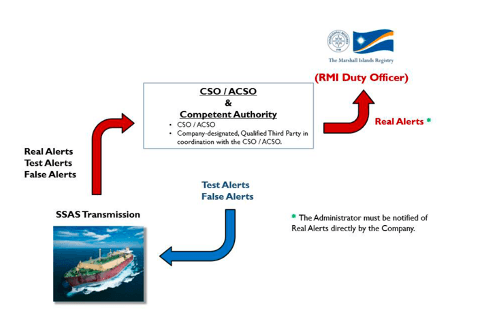
In compliance with SOLAS Chapter XI-2 Regulation 6, the ship is fitted with a Shipboard Security Alert System which can be activated from the bridge and another location. Special consideration must be given to how the buttons are protected from accidentally being activated. Testing of this system will occur regularly at a convenient time arranged between Ship and Shore. This shall be conducted at least every 6 months.
7.6. AIS Transponder
In compliance with SOLAS Chapter V Regulation 19, the yacht is fitted with an AIS Transponder.
7.7. Yacht Identification Number
To comply with SOLAS Chapter XI-1 Regulation 3 the yacht identification (IMO) number is permanently marked as required by the Flag Administration of this yacht.
7.8. Dual Use Equipment
The following equipment will have a dual-use; that is its primary function is not related to security:
- All exterior deck lighting;
- All floodlights and searchlights;
- All fixed communication systems;
- All portable communication systems including mobile ‘phones;
- All doors, ports, scuttles and openings that can be secured.
7.9. Critical Security Equipment
The SSO is responsible for identifying critical security equipment. The Critical Security Equipment list is used for Monthly maintenance procedures.
8. Communication
8.1. Scope
An effective two-way communication system will be established with the CSO so that any unlawful act against the yacht or person can be reported immediately using the appropriate format.
| Location of the yacht | (Lat/Long/Time) |
|---|---|
| Victim | Name/Nationality/Dates and Place of Birth |
| Person(s) committing an unlawful act | Name/Nationality/Dates and Place of Birth |
| Nature and extent of severity of injuries sustained |
Handheld radios shall be employed as the primary means of communication, with intercom/phone used as a backup. All crew members have a handheld radio in port. Even if handheld radio used onboard are encrypted, the crew are encouraged not to give real or distinctive names, and use code names instead, like “The Captain”, “the owner”, or first name only.
Communications with port facility operator’s personnel will be coordinated directly or through the agent where applicable with preference given to handheld radio and/or telephone. For security purposes, direct communications links will be established between yacht security personnel and the security personnel in the port facility. Those links will be subject to periodic testing and failure to maintain communication will be reported immediately to the SSO.
SSOs are required to communicate directly with CSO, via telephone or e-mail as necessary to coordinate security operations and support requirements and provide updated port contact information.
If the yacht is operating at a higher security level than that set for the port it intends to enter the SSO shall advise without delay the PFSO of that port. The PFSO must confirm that the Port State will be formally advised. If such positive confirmation is not received or is in doubt the SSO shall advise the relevant Port State.
8.2. Distress and Duress
The SSO will initiate a procedure so that any crew member can indicate that he is involved in a security alert and is communicating under duress. This procedure will consist of a keyword or phrase that when used in communications, whether verbal or written, will indicate that the speaker or sender is acting under duress and that a security alert must be initiated. This keyword or phrase must be known to all crew and the CSO.
Use of this keyword or phrase is to be included in training, drills and exercises.
8.3. Equipment on Board
Port / Coastal Authorities
- VHF DSC
- SSB
- Satcom
- GSM Phone
- AIS
Flag Administration
- Satcom
- GSM Phone
- Ship Security Alert
Yachting Concept Monaco
- Satcom
- GSM Phone
- Ship Security Alert
Boats & Tenders
- VHF + UHF
- GSM Phone
Internal Communications
- Internal phone system
- VHF & UHF
Caution
All communications on VHF are not crypted and should be used with caution. Avoid using real names or distinctive information. Use code names instead.
9. Restricted area
9.1. Company Policy
It is Company Policy that restricted areas are locked unless needed for operational reasons to remain open as decided by the Captain, Chief Officer or Chief Engineer. A responsible crew member shall accompany visitors to restricted areas subject to the discretion of the Captain. Restricted areas are to be marked.
Restricted areas are the:
- Navigation Bridge, captain’s cabin and A/V rack room
- Engine room and ECR
- Garage
- Emergency Generator Room
- All other crew areas will be also marked as restricted areas (even though they are not part of the SSP)
9.2. Keys
- The Captain is responsible for the key issue, control and procedures.
- The issuance of keys, particularly Master keys, is to be controlled and documented and kept to a minimum.
- Lost, stolen or missing keys are to be reported immediately to the SSO who will take appropriate and immediate action to secure the relevant area and investigate the loss or theft. If theft is suspected a report is to be made to the CSO.
- Arrangements for out of hours crew access to be agreed by the SSO accordingly
9.3. Key Code Pads
A keypad entry system is located at the crew entrance on the port side main deck. The entry code is changed every quarter, following a large change in crew or whenever it is suspected that to not do so could lead to a breach in security.
10. Security Levels
The yacht is required to set her security level based on the level set by the visited country, port facility or as per required the local authority. The yacht must declare her level of security in advance prior visiting a port facility.
At security level 1, the following activities shall be carried out, through appropriate measures in order to identify and take preventive measures against security incidents:
- Ensuring the performance of all ship security duties;
- Controlling access to the yacht;
- Controlling the embarkation of persons and their effects;
- Monitoring restricted areas to ensure that only authorised persons have access;
- Monitoring of deck areas and areas surrounding the ship;
- Supervising the handling of cargo and shipís stores; and
- Ensuring that security communication is readily available.
At security level 2 and 3, the additional protective measures, specified in this ship security plan, shall be implemented. The Master / CSO shall inform the visiting country authorities to the current level and request an acknowledgment.
A Declaration of Security (DoS) should be completed when the Contracting Government of the port facility deems it to be necessary or when the yacht deems it necessary. Only the master or the SSO are allowed to complete the DoS. The DoS is limited for a specific period of time and should be redeemed in the stay extends the limit of the DoS.
Contracting Governments shall determine when a Declaration of Security is required by assessing the risk the ship/port interface or ship to ship activity poses to people, property or the environment.
The yacht can request completion of a Declaration of Security when:
- the ship is operating at a higher security level than the port facility;
- there has been a security threat or a security incident involving the yacht or involving the port facility,
- whenever the Master deems it is necessary due to the yacht activities.
The Master / CSO must acknowledge using the DoS that he/she recognised the port facility security level, and especially if the level is set to level 2 or 3. In case the yacht or the port change the level of security, a new DoS must be requested by the party who change the level and the other shall acknowledge. In case the change is requested by the visiting authorities, the Master / CSO must acknowledge immediately by any means (preferably by mail) and set the same level promptly. The Master / CSO shall report the implementation of the new level or any difficulties in implementation.
General rule for the Master / CSO:
- The yacht is set to the port level
- The yacht shall acknowledge the level is set to 2 or 3 by the authorities by any means immediately
- The yacht shall the change the board level according to the port facility
- The Master/CSO - PFSO use an updated DoS to formalise the acknowledgment
An example of a DoS is provided in the annexes.
10.1. Security Level 1
- General Requirements for Security:
- All crew members will review and exercise their security duties and responsibilities through drills and training.
- Security information is to be provided to all crew members, and any security personnel and guests if appropriate. Such information to include the security level and any specific threat information.
- Ship Security Officer (SSO) will communicate with each port and any specific waterfront facility to co-ordinate protective measures.
- Monitoring Restricted Areas to ensure that only authorized personnel have access:
- Restricted areas are to be locked unless needed for operational reasons as decided by the Captain, SSO, Chief Officer, Chief Engineer or Chief Stewardess.
- Measures for Controlling Access to the Yacht:
- Limit access points to the yacht and close external doors.
- Gangway monitored by duty watch and CCTV or raised and inaccessible.
- All spaces on the vessel are normally kept locked out of working hours.
- Measures for Monitoring Deck and Areas Surrounding the Yacht
- At night sufficient light is provided to allow the crew to see both quaysides and overside.
- Measures for Controlling Visitors
- Verify reason personnel are embarking the vessel by using work orders, or other means.
- Positively identify crew members, guests, visitors and other personnel before each embarkation. Those unwilling or unable to establish their identity and/or to confirm the purpose of their visit when requested to do so must be denied access to the yacht and the SSO must be alerted. The SSO will report the incident immediately to the CSO and the PFSO with a formal request that the PFSO alert the appropriate authorities with security responsibilities.
- Verify arriving crew as authorized to serve aboard the vessel.
- Visually inspect all and random physical inspection of at least 5% of personal baggage, carry-on items and personal gear for prohibited weapons, incendiaries and explosives.
- Measures for Supervising the Handling of Stores and Baggage:
- Visually inspect all and random physical inspection of at least 5% of stores, spares, provisions and baggage for prohibited weapons, incendiaries and explosives.
- All unaccompanied baggage must be inspected and purpose confirmed before being placed on board. Any suspect baggage is not to be handled, is to remain ashore and the SSO must immediately inform the PFSO.
- Immediate secure stowage of stores, spares, provisions and baggage.
- Measures for Ensuring Port-Specific and all other Security Communication:
- Perform regular communications checks.
- Provide a backup means of communication.
- Measures for Responding to Security Threats or Breaches of Security:
- Inform SSO and Captain immediately by the most secure means consistent with personal safety.
- Inform PFSO immediately by the most secure means consistent with personal safety.
- Inform CSO, Coastal State if at sea, Flag immediately by the most secure.
10.2. Security Level 2
Changes from Security level 1
Increase from Security level 1 to level 2 within 10 minutes
- Requirements for Monitoring Restricted Areas to ensure that only authorized personnel have Access:
- Locking or securing access to restricted areas.
- Using extra security personnel as guards and for patrols: The frequency and detail of monitoring of restricted areas include dedicating personnel to guarding or patrolling restricted areas.
- Doors in escape routes must be capable of being opened when secured from the direction for which escape is required.
- Measures for Controlling Access to the yacht:
- Assign additional personnel and/or lift all gangways.
- Co-ordinate with the PFSO to extend access control beyond the immediate area of the vessel.
- Measures for Monitoring Deck and Areas Surrounding the Yacht:
- Use security lookouts and/or security patrols. If necessary, increase the number and frequency of security patrols and use waterside boat patrols to ensure continuous monitoring.
- Underway – maximum lighting available consistent with safe navigation.
- Underway – consider trailing floating lines to hinder the approach of small vessels from astern.
- Perform waterside boat patrols, if required by the port facility or in response to specific threat information.
- At these higher security levels, additional lighting will be co-ordinated with the waterfront facility to provide additional shore side lighting. Additional lighting may include using spotlights and floodlights to enhance the visibility of the deck and areas surrounding the vessel and using lighting to enhance the visibility of the surrounding water and waterline.
- Measures for controlling visitors:
- Escort all visitors and other personnel to their host.
- In conjunction with port create secure shore inspection area if necessary.
- Visually inspect all and random physical inspection of 25% of personal baggage, carry-on items and personal gear for prohibited weapons, incendiaries and explosives.
- Measures for Supervising the Handling of Stores and Baggage:
- Visually inspect all and random physical inspection of 35-50% of stores, spares, provisions and baggage for prohibited weapons, incendiaries and explosives.
- Measures for Responding to Security Threats or Breaches of Security:
- Inform guests (usually via Captain) immediately by the most secure means consistent with personal safety.
- Consider retreat to secure area or depart the ship in port or muster and abandon ship at sea as practised in drills and exercises.
- Measures for Responding to Increased Security Level or Instructions from Flag Administration:
- SSO has authority to engage shore-based security resources if necessary.
10.3. Security Level 3
Changes from Security level 2
Increase from Security level 2 to level 3 within 10 minutes
- Requirements for monitoring restricted areas to ensure that only authorized personnel have access:
- Using extra security personnel as guards and for patrols, posting personnel to continuously guard restricted areas and/or assigning personnel to continuously patrol restricted areas and areas adjacent to restricted areas.
- Measures for controlling access to the yacht:
- Permanent watch on aft and side decks.
- All interior access points locked.
- Gangway retracted or raised.
- Co-ordinate with the PFSO to extend access control beyond the immediate area of the vessel.
- Measures for monitoring deck and areas surrounding the yacht:
- Use security lookouts and/or security patrols to ensure continuous monitoring.
- Measures for controlling visitors:
- Limit entry only to crew and guests, essential service providers and incident responders and duly authorised officers of Contracting Governments.
- Escort at all times all essential service providers and escort incident responders as reasonably and safely practicable.
- Inspection of 100% of personal baggage, carry-on items and personal gear for prohibited weapons, incendiaries and explosives.
- Measures for supervising the handling of stores and baggage:
- Inspection of 100% of stores, spares or provisions for prohibited weapons, incendiaries and explosives.
11. Screening for weapons
Screening is carried out by observation, physical and electronic methods as available. A Screening system that should be capable of detecting prohibited weapons, incendiaries and explosives is available to the SSO and the duty watch crew should be trained to use it.
Screening by observation must be on-going as part of the normal operations of the yacht. SSO training will cover this type of screening.
Although landside screening is generally preferred, the screening of smaller items (i.e.: personal effects, cabin baggage, individually packaged stores) need not take place outside the boundaries of the ship provided that the screening area onboard the ship is adequately restricted and suspicious items can be removed before storage.
A female security staff member should be suitably trained and tasked to conduct screening of female guests and crew commensurate with applicable Security Levels.
Anyone refusing to submit to security screening at a point of access shall not be allowed to board the ship and will be reported to the appropriate authorities.
12. Gangway
Personnel detailed for gangway duty must be given Standing Orders. The following is an outline of what should be included in these Standing Orders:
- All gangway personnel are responsible to the SSO/OOW and must notify them if in doubt on any matter by telephoning appropriate number or by hand radio.
- Those on gangway duty must not leave the station until properly relieved.
- No one is to be permitted to board without positive confirmation of their identity, purpose of visit, the person to be visited and a crew member assigned to monitor the person.
- Visitors for whom positive ID is not yet established are to remain ashore.
- Visitors whose ID cannot be satisfactorily established are to be refused entry.
- The gangway must be checked to see that it is properly secured at all times safe for use within its permitted angles of elevation and that it can range freely with the tide or harbour swell.
- A watch shall be maintained for unauthorized removal of the ship’s equipment and stores.
- All communication devices are to be tested at least once per watch.
- Nothing is to disturb the gangway watch in the performance of these duties and, if necessary, they are to call the SSO/OOW for assistance.
- If necessary extra staff can be engaged to avoid disruption or delay to the embarkation/disembarkation of guests.
13. Contingency procedures
13.1. General requirements
The following procedures are to be followed in the following circumstances that present a threat to the security of the ship:
- Bomb Threats/Searches
- Evacuation of the Vessel
- Response to Breach of Security or Suspicious Activity on, or near, the Vessel
- Piracy
- Stowaway search
However, it is recognized that not all contingencies can be planned for in advance, so the Captain, the SSO and security staff members are authorized to take whatever action they deem necessary for the safety of the yacht, crew, and guests in situations where these procedures are not appropriate.
13.2. Evacuation of the yacht
Evacuation of the yacht should be strongly considered as possible action if a bomb or suspicious package is found on board.
The Captain has the ultimate authority to order the evacuation although any crew member acting on reasonable suspicion should take responsibility for alerting all on board, particularly in the port where an emergency disembarkation is normally a safe option.
The evacuation should, as far as practicable, comply with the muster list. Local authorities should be advised promptly.
13.3. Response to breach of security or suspicious activity on or near the yacht.
If any suspicious activity in or near the yacht is recognised, the SSO or the OOW should be informed immediately. The SSO or OOW should advise the Captain who should advise the CSO and nearest and most appropriate shore and/or flag authority.
There is a panic word that the crew can call on their portable radio to inform the rest of the crew that there are facing a breach of security or a security incident. During every security drill, the word is only given by word of mouth, is never written anywhere and will change every year.
14. Swimmers
14.1. General
When moored or anchored, ships are extremely vulnerable to attack by swimmers and divers. The most advantageous time for such occurrences is during the night or low visibility. This part will set procedures that will assist in the defence against swimmer attacks.
14.2. Requirements
If the local threat warrants that an anti-swimmer watch is established, the following procedures will be incorporated:
- Shipboard lighting will be turned on to prevent shadow areas;
- Searchlights will be manned;
- Moving patrol will be established;
- Moving patrol will be given specific instructions to focus effort on the waterline;
- The patrol should be issued portable spotlight;
- The patrol should pay particular attention to the area between ship and dock;
- The patrol should pay particular attention to the area under gangway.
- The frequent and irregular turning of the ship’s crew in both directions and movement of rudder will occur;
- With assistance from the local agent, a patrol boat will be established;
- If not already done so incorporate rat guards and chain hawse pipe covers;
- Have fire hoses charged and laid out;
- Lock as many deck doors as possible to control access.
If an unauthorised swimmer has been identified, the following steps will be incorporated:
- The patrol will sound the alarm;
- The crew will report to designated areas;
- Local authorities will be notified of the situation;
- An attempt will be made to gain the attention of the swimmer and direct him away from the ship;
- If this fall, fire hoses will be aimed at an area in between the ship and swimmer;
- If the swimmer is still persistent, fire hoses will be aimed directly at swimmer for a period of no longer than 5 seconds interval.
15. Bomb threat
Every bomb threat will be taken seriously and the response will be immediate and systematic. This part will establish the procedures and responsibilities for the ship and the crew.
15.1. Responsibilities
The Master has the overall responsibility in determining whether, when and for how long to search.
The SSO will ensure that all posts, bridge and major work areas have a copy of the telephonic bomb threat checklist. He will be responsible for an orderly evacuation when it is deemed necessary, and for ensuring all necessary notifications are made. A Copy of a Bomb Thread checklist is available in the annexes.
15.2. Bomb threat notification
Any individual who has received a bomb threat will immediately notify the Master, SSO or Officer of the Watch (OOW). The person receiving a bomb threat should keep the caller on the line as long as possible and complete as much as possible in the telephonic Bomb Threat Checklist. The Master or SSO will then make the necessary notifications following the Bomb Threat Action.
15.3. Determining whether to search or evacuate
The Master has the overall responsibility in determining whether, when and for how long to search. This should be based on the following information:
- The recent security posture of the vessel;
- Conduct a risk evaluation related to recent ports of call;
- Amount of time since last in port;
- The validity of the message;
- Recent stores, equipment, mail received on board;
- Any recent unrest by the crew;
- Stowaways recently disembarked.
Once it has been determined that the threat may be real and a bomb alert justified, the SSO, at the discretion of the Master, will then assume overall responsibility. The SSO will use the bomb threat check-off list as a guide for a course of action.
The SSO will decide to conduct an Obvious or Hidden type of search. This will be based on the amount of time available to search. The SSO should leave a thirty minutes window between time of detonation and the conclusion of the search.
- Overt type search: This type of search will be used when the time to search is limited. All crew members will search for the bomb in their perspective areas.
- Covert type search: This type of search is ideally the preferred one. Only a pre-selected search team will search for the bomb.
The Master will have the overall responsibility of determining whether to evacuate. Generally, the Master should weigh the validity of the threat compared to the effect of the work stoppage.
15.4. Actions to take
- In port:
- Cease operations;
- Secure tanks and watertight compartments;
- Prepare to activate firefighting systems;
- Prepare ship for departure.
- At sea:
- Cease any special operations;
- Secure tanks and watertight compartments;
- Prepare to activate firefighting systems;
- If possible, move the ship to shallow water and anchor to facilitate evacuation
15.5. Bomb search teams
Search teams consist of three or five-person teams. Broken down into a team leader and two or four team members.
Team leader duties and responsibilities are:
- Controls the search team;
- Designates high man and low man;
- Ensures search is slow, deliberate and methodical;
- Sketches the room if a suspicious item is found;
- Does not take an active part in the search.
Search team duties and responsibilities are:
- Search;
- Be slow, deliberate and methodical;
- Never touch or move a suspicious item;
- Nothing should be turned on or off;
- Members should stay in their designated area of search;
- The high man should always stay behind the Lowman.
15.6. Bomb search procedures
The search should begin in common areas where most people have access to and proceed to more restricted areas if no location was specified.
- Bomb condition I: No location or time information obtained
- Sound security alert;
- Muster crew;
- Close watertight and fire doors;
- Send search team or teams to the area indicated to conduct a thorough search for the bomb. All other personnel will stand clear;
- Should a bomb or suspicious item be found, no effort should be made to move the device;
- If no bomb is found, commence a detailed search of the ship.
- Bomb condition II: Exact location is given, no time information received
- Sound security alert;
- Muster crew;
- Close watertight and fire doors;
- Send search team or teams to the area indicated to conduct a thorough search for the bomb. All other personnel will stand clear;
- Should a bomb or suspicious item be found, no effort should be made to move the device;
- If no bomb is found, commence a detailed search of the ship.
- Bomb condition III: Exact location and time information received. Proceed as in bomb condition II except:
- The area will be evacuated immediately
- Close watertight and fire doors;
- A thorough search is conducted;
- If no bomb is found, the area will remain empty until the specified time of detonation has been surpassed by at least 30 minutes;
- If bomb/device is found, proceed as in bomb condition II.
15.7. Bomb or suspicious item located
- Do not attempt to move or interference with it in any way;
- Do not pour water on it;
- Use mattresses or sandbags to minimize blast effects, but do not cover it up;
- Consider closing selected fire doors to minimize the effect of a blast;
- Keep in mind that there may be more than one bomb;
- Inform authorities of description and location;
- If at sea, head for an agreed-upon port or shallow water.
15.8. Bomb threat action checklist
| 01 | Record the bomb threat telephone call. |
|---|---|
| 02 | Preserve written or postal bomb threats; avoid further handling |
| 03 | Evaluate bomb threat |
| 04 | Consider evacuation |
| 05 | Sound General Alarm |
| 06 | Close Watertight doors |
| 07 | Consider getting underway to clear the pier or other ships, if appropriate to do so |
| 08 | Notify, as appropriate and feasible |
| 09 | 1. Master and Ship Security Officer, whether onboard or ashore |
| 2. Port authority; | |
| 3. Local police; | |
| 4. Local fire department; | |
| 5. Local ambulance service; | |
| 6. Local Coast Guards | |
| 10 | Break out emergency gear; lead out fire hoses |
| 11 | Commence search |
| 12 | Do not move or touch a strange or suspicious object or anything attached thereto |
| 13 | Place sandbags or mattresses, not metal shield plates around the object, do not attempt to cover the object |
| 14 | Leave disarming and removal of a bomb or suspicious object to the local professionals in explosives disposal |
17. Chemical, Biological or Radiological (CBR) control
An attack upon a ship using a chemical, biological or radiological agent is a very real possibility. This form of attack can be initiated in many different ways. It is essential that if the ship has been exposed to some form of an agent or an attack is expected, that the crew take immediate precautions.
Because there is a wide range of sources and delivery methods, the following procedures are designed as an overall course of protection from CBR agents. It may be necessary for the Master or SSO to make additional considerations as needed.
17.1. Chemical agents
Chemical agents can be delivered to a target by a variety of ways to include pressure sprayers and explosive dispersal. Some common symptoms of a chemical agent are skin irritation or burning, burning of eyes, burning of lungs and throat, chest constriction, nausea or vomiting, convulsions.
The following procedures will be used if the ship has been exposed to a chemical agent:
- Sound security alarm and announce a possible chemical attack;
- Notify local authorities;
- Steer ship away from the exposed area;
- Secure all access to weather decks;
- Shut down ventilation systems;
- Initiate wash down procedures to begin decontamination.
17.2. Biological agents
Like chemical agents, biological agents can be spread by a variety of means. Generally, biological agents do not have an immediate effect and, therefore, are not detected until there has been extended exposure. Some common symptoms of a biological agent are pneumonia, blood poisoning, bleeding from gums or orifices, troubled breathing or respiratory failure, severe nausea, vomiting or diarrhoea.
The following procedures will be used if the ship has been exposed to a biological agent:
- Sound security alarm and announce possible biological attack;
- Notify local authorities;
- Pull away from the port to limit exposure to others;
- Shut down all ventilation systems;
- Close all hatches to limit exposure of agent;
- Separate crew into at least 3 groups:
- Showing symptoms of the agent,
- Probably exposed to the agent,
- Probably not exposed to the agent.
- Cease all eating and drinking until determined not to be contaminated.
- Initiate wash down of ship.
17.3. Radiological agents
Exposure to radiological agents is not limited to a nuclear explosion. They can be released by conventional explosives (i.e. “Dirty Bombs”). Radiological agents can also be released without any type of explosion and just by simple exposure can cause radiological poisoning and even death. Some common symptoms of exposure to a radiological agent are nausea, vomiting, internal bleeding.
The following procedures will be used if the ship has been exposed to a radiological agent:
- Sound security alarm and announce possible radiological attack;
- Notify local authorities;
- Pull away from the port to limit exposure to others;
- Shut down all ventilation systems;
- Close all hatches to limit exposure of agent;
- Initiate wash down of ship.
18. Civil disturbance
It is not uncommon for there to be demonstrations at pier sides in foreign countries. Generally, the demonstrators are protesting a foreign government. Demonstrations that are well organized generally stay under control. Demonstrations that do not seem to be adequately led can quickly turn into riots. Regardless of which type of demonstration is happening the ship must take outlined security measures and be ready to sail out on short notice.
If the ship is required to pull into a port where there is to be a scheduled demonstration or where an announced protest has begun the following measures should be implemented:
18.1. Scheduled demonstration
These are generally more controlled and the host country has had the proper time to implement security measures.
- Request to leave port before the demonstration or avoid pulling into port altogether;
- Implement Security Level 2;
- Raise the gangway;
- Pull vessel off the pier if feasible (with anchors);
- Stage fire hoses for charging;
- Restrict liberty to 4 hours before the scheduled demonstration;
- If possible, stay at anchor;
- Restrict visit during a demonstration to emergencies only;
- While in port all nationals should be escorted at all times;
- The ship should be prepared to get underway on short notice;
- Increase security drills.
18.2. Unscheduled demonstration
Unscheduled protests are generally disorganized. Due to the lack of leadership and control, these types of protests usually and quickly become a mob. These types of demonstrations will usually lead to violence and destruction. The host country will probably not be prepared or capable of controlling the mob’s actions. In the event of an unscheduled demonstration, the following procedures should be implemented:
- Sound security alert;
- Cease all operations;
- Conduct immediate recall of all crew members;
- Do not attempt to break lines of protestors to reach the ship,
- Seek safe haven with local authorities or government body.
- Request permission to leave port;
- If unable to get underway, pull away from pier and anchor;
- Stage and charge fire hoses;
- Secure all gangways;
- Instruct crew not to antagonise protestors.
19. Irritated employee
A disgruntled employee can be one of the most damaging threats that a ship or crew can have, simply because a crew member will have unlimited access to most parts of the ship and will most likely be overlooked as a threat. An employee may be disgruntled for numerous reasons: upset with the current work situation, financial problems, mental status or family issues, to name a few. Everyone gets upset at times and this part is only designed for persons who appear to have stepped beyond the accepted level of normalcy in regards to being upset.
Once it has been determined that a crew member poses a potential threat to the ship or crew, the following measures should be implemented:
The employee has not committed or implied a threat to the ship or crew
It is very important how an employee is handled at this stage. You must keep in mind that at this point, no action has been taken by the employee. The employee should not be treated as a criminal or a sub-standard employee. If, after speaking with the employee, you feel that the employee may pose a threat, the following will be implemented:
- Remove employee from critical work assignments;
- Notify Company Security Officer;
- Limit employee’s access to vital areas;
- Monitor employee.
The employee has made plausible threats to the safety
- The employee should be secured to the berthing area, or detained (Captain to assess);
- Search for berthing area to remove potential weapons;
- Establish a two-man watch on the employee;
- Movement aboard the ship should be limited to common areas and escorted at all times;
- Contact Company Security Officer;
- Make preparations to remove the employee from the ship at the next port or first available opportunity;
- Contact with other employees should be limited.
The employee has attempted to or committed an act against ship or crew
- The employee should be immediately detained;
- Search for employee and berthing area to remove potential weapons;
- Establish a two-man watch on the employee;
- Contact Company Security Officer;
- The employee will be detained in individual berthing;
- The employee will be kept under constant watch at least by two persons;
- All evidence will be secured;
- Take written reports of all witnesses;
- Make preparations to remove the employee from the ship at the next port or first available opportunity;
20. Hostage situation
Hostage seizures have been some of the most sensational terrorist and criminal acts of the last 30 years. This part will include the required steps to enter, proceed and finalize the process of hostage negotiations. It will assign responsibilities, promulgate procedures and provide guidance for personnel to deal with a hostage situation until other agencies or higher authority arrives on the scene.
20.1. Duties and responsibilities
Depending on the area of the jurisdiction you are, National authority has the primary and overall responsibility for the direction of operations associated with terrorist/hostage situations.
The SSO will:
- Be familiar with all information contained herein;
- Ensure that ship’s crew is aware of the provisions of this part.
20.2. Procedures and rules for hostage situations
- Locate the hostage situation and isolate the site to the smallest possible area;
- Establish a command post;
- Set up perimeters:
- Inner perimeter: established as close to the hostage sight as possible. Ensure perimeter is safe from the hostage-takers for security personnel;
- Outer perimeter: acts as a buffer zone to control entry and exit to the inner perimeter.
- Do not display a threatening force to hostage holders. Keep the area non-threatening and low key;
- Evacuate non-affected spaces of all non-essential personnel;
- Establish a log to record all information and designate one person as the recorder. The recorder will log all occurrences, including times;
- Keep calm and attempt to establish communications with the hostage-takers:
- Remember a demand need not be prefaced by the words: “I need”, “I want”, “I demand”, “get me”, “give me” or any violent threats. You must listen to what is being said;
- Assure the hostage-takers that everything will be done that can be done, but you do not have the authority to meet their immediate demands;
- Show concern for all, especially the hostage-takers. Do not over-value the hostages; it gives the hostage-taker a sense of power;
- Once communication has been established, do not hang up (if on the telephone), leave or turn your back on the hostage-takers. Keep them talking;
- Do not let them see you whisper to others. It may create a paranoid situation;
- Do not make promises;
- Do not use violent words;
- Never give anything without getting something in return. Set a pattern of giving and take;
- The negotiator should exhibit no emotion, don’t be excited and use a calm voice;
- Do not give orders to the hostage-takers;
- One person ONLY will be the negotiator. He will have no authority of his own.
- Do not exchange hostages (do not send someone in place of a hostage already held);
- Do not agree to provide transportation, alcohol, drugs or weapons;
- The rule for hostage negotiations is DYNAMIC INACTIVITY. Give the impression of activity without taking any action;
- Make the hostage-takers believe you genuinely understand their plight. Have empathy for them and show understanding for their cause, but do nothing. Do not show an agreement or a motivation for their cause, this may be taken in a negative manner believing you are mocking or making fun of their cause;
- TIME IS ON YOUR SIDE. The negotiating process can be a long and tiring experience, so patience is necessary.
20.3. Information needed in a hostage situation
In any hostage situation, certain information must be developed. This information in the check sheet form is included, titled “Hostage Situation Management”.
20.4. Resolving a hostage situation
There are two courses of action for resolving a situation:
- Immediate assault: The least desirable outcome, this course should never be used unless absolutely necessary, and then should only be done by persons who are trained in assaulting spaces. This course of action is intended to be used when hostage-takers have begun to deliberately cause life-threatening harm to the hostages. This course of action should not be attempted if the safety of the assault force cannot realistically be assured. Do not add to the number of bodies to be injured or killed;
- Contain and negotiate: This is the preferred course of action. Local governments can provide trained professionals to do the negotiating. However, this can take some time, or the ship may be at sea, so the ship may need to assume the role until the arrival of a trained negotiator. Some immediate steps to be taken are:
- Determine the identity of the hostage(s);
- Determine the identity of the hostage-taker(s);
- Evacuate unnecessary personnel;
- Prevent the possibility of escape;
- Maintain the status quo. Attempt to freeze the situation;
- Plan a course of action and alternatives;
- Obtain shipboard schematics, plans, etc. and keep them available in the command post;
- The Master should ensure external contacts for receipt of resources and notification of superiors has been accomplished;
- Act as negotiator/communicator until a trained person arrives aboard;
- The engineering department will prepare to isolate systems (water, air, etc.) to the hostage site as directed by the SSO or government authorities.
21. Piracy
Piracy has been a problem for the maritime industry for centuries and remains so today. Piracy is still prevalent in many parts of the world, South East Asia, Africa, South America and the Caribbean to name a few. Tactics of the old world are still being used as successfully today as they were two hundred years ago.
Pirates rely heavily on the element of surprise. Therefore, the ship watches must remain vigilant and the crew react quickly to a potential pirate attack. Most pirate attacks are diverted when it is apparent that the crew is aware of the pirates.
The following procedures can be incorporated while entering a high threat area or in the event of a pirate attack, or at the discretion of the Master:
21.1. Approaching or entering a high threat area
- Conduct anti-piracy drills based on SSP;
- Brief the crew on recent piracy events in the area or obtain piracy report from company or agent as soon as practicable;
- Periodically call in position to the Rescue Coordination Centre;
- Secure and inspect spaces not in use;
- Increase the watch;
- Arm the watch with a baton;
- Increase lighting on weather decks and waterline;
- Stage fire hoses and prepare for charging;
- Strategically place fire axes;
- Consider relocating bulk cash;
- Secure all portholes.
21.2. While in port or anchored
- Applicable measures from above;
- Delay anchoring;
- Increase security drills;
- Limit access to essential persons only;
- Photograph all persons boarding the ship;
- Use rat guards;
- Incorporate anti-swimmer watch;
- Non-essential crew stay in secure areas at night.
21.3. Suspected piracy ship detected
- Activate searchlights and direct them at the suspected ship;
- Alert Rescue Coordination Centre of the situation;
- Sound the alarm and assume security positions;
- Charge fire hoses.
21.4. Piracy attempt is imminent
- Notify Rescue Coordination Centre of imminent attack;
- Begin aggressive steering manoeuvres;
- Maintain maximum speed if navigation allows;
- Warn other ships in the area of imminent attack;
- Use spotlights to blind pirates;
- Aim fire hoses at the ship in an attempt to swamp ship;
- Aim fire hoses directly at persons attempting to board;
- Use fire axes to cast off grappling hooks and poles.
21.5. Pirates start to board the ship
It is essential for the safety of the crew, that, as soon as it has been determined that boarding is inevitable, all crew should be ordered to a citadel.
- Sound alarm to alert crew members to seek citadel;
- Take immediate headcount;
- Maintain control over navigation systems;
- Seek the earliest departure of pirates;
- Convince pirates they have everything.
21.6. Pirates start to leave the ship
- Do not attempt to stop pirates;
- Allow pirates to take items they have obtained;
- Stay in citadels until the bridge has given the signal for all clear.
21.7. Pirates have left the ship
- Notify Rescue Coordination Centre, report the following information:
- Direction pirates headed;
- Description of the boat;
- Number of pirates;
- Weapons pirates used;
- Injuries sustained by the pirates;
- Injuries to crew members;
- Conduct headcount of crew members;
- Conduct a thorough search of all compartments;
- Conduct inventory of ship’s inventory;
- Notify company security officer of incident.
It is identified that, if pirates take control of the ship (navigation control), the SSAS should be activated as soon as possible to inform the national authority of this loss of control.
22. Refugees
Refugee recovery at sea is not only a humanitarian act, it is also International Law. A ship should assist any person found at sea in danger of being lost. A ship should also proceed with all possible speed to the rescue of persons in distress. If informed of their need of assistance, in so far as such action may reasonably be expected to him.
Handling refugees is a delicate matter, they may be extremely fearful, not knowing how you and your crew will treat them. It is necessary to show the refugees that you are here to help them, and not hurt them in any way. There have been cases where refugees have attempted to take over a ship out of fear of being mistreated or killed.
Whenever refugees are found, the following procedures should be followed:
22.1. Contact Rescue Coordination Centre for assistance
- If in coastal waters, attempt to let the local authorities assume the responsibility and burden of handling refugees.
- If not near coastal waters, or local authorities refuse to assist, then you will be responsible for assisting the refugees.
22.2. Stay with refugees until local authorities take over the situation
For the safety of the refugees, the ship must stay with them until such time that local authorities take control of the situation.
22.3. Determine if the refugee’s ship is seaworthy
If their ship is deemed seaworthy, then the refugees should remain aboard their ship. They should be given fresh water and food. A watch should be incorporated to watch over ship for safety and security. If the ship is not seaworthy, then refugees must be taken aboard.
22.4. Establish an inner and outer security perimeter
The inner perimeter will be established on the main deck aft and swim platform.
The inner perimeter should be separated into two identifiable parts:
- Processing: the swim platform will be where refugees are taken aboard, searched and information recorded; A picture/video of each refugee is also taken
- Holding: This is the area where the refugees will remain until turned over to local authorities.
Inner security perimeter will consist of an unarmed search team, recorder and one person armed with a baton.
The outer perimeter will be established on the next adjacent deck. The outer perimeter will consist of two watches armed with fire hoses.
22.5. Bringing refugees on board
Bring refugees on board and process one at a time.
Conduct search of refugees. Make sure that the search team wear latex gloves and masks. Refugees may be carriers of infectious diseases.
Personal belongings should be inspected for identification and items to be confiscated:
- Keep in mind that these belongings are all that the refugee owns and will be highly valued. Items should be handled with care;
- Items that should be confiscated are weapons, weapons of opportunity, contraband and identification;
- Once personal belongings have been searched, give them back to the refugee, this will have a calming effect.
- Record name, country of origin, personal property, visible injuries, description and any other information that will assist with their debarkation.
- Video the process for future reference.
- Once processed, the refugee should be placed in the holding area and the next refugee brought aboard.
22.6. Notify company security officer
It is becoming more and more difficult to disembark refugees. Therefore, the CSO must be notified as soon as possible, so the legal and political process to disembark the refugees can start immediately.
22.7. Maintaining refugees
- The watch should be maintained on refugees at all times.
- Food and water should be provided to refugees.
- Provide medical attention as needed.
- Protect from the elements.
- Provide temporary bathing and toilet facilities.
22.8. Disembarkation of refugees
- Ensure refugees have personal belongings.
- Turn over any confiscated materials to the governing authority.
- Give copies of all documentation to governing authority.
- Disinfest area where refugees were held.
- Submit report and copies of all information to CSO.
23. Internal audit procedure
23.1. Scope
The purpose of this procedure is to fully meet the requirements for internal security audits, required by the ISPS Code.
23.2. Responsibilities
- The CSO is responsible for ensuring that an annual schedule for internal audits of office and ships is set and maintained.
- The CSO is responsible for performing audits of ships as required by the schedule, or where this is not appropriate by delegation to appropriately trained persons*,* e. one who has received Audit and Ship Security Officer training,
- The CSO is responsible for creating and maintaining a suitable checklist for audit.
23.3. Detail
The CSO shall, by January each year, prepare a schedule for the year's internal security and safety audits. This schedule includes all areas and activities which relate to the security safety and environmental protection aspects of Company operations.
This schedule shall take account of:
- The importance of each site or activity.
- The number of problems being experienced with each particular site or activity.
Certain areas or activities may require to be audited more than once a year. Particular problem areas may require to be audited at times additional to the schedule. The schedule will detail the month (but not the day of the month) when the audit shall take place.
The auditor shall have access to all necessary documentation. If practicable this shall be made available at least two weeks before the date of the audit. At the opening meeting, the auditor shall explain the scope of the audit and the method of reporting. The audit shall be carried out using the checklists prepared.
The audit shall be reported by completing a Non-Conformity note. Observations may also be raised to indicate potential risks to the management system. Any non-Conformity raised shall be agreed by the guide and later signed by the person responsible for the area being audited. A closing meeting shall be held at which the auditor shall present a summary of findings and agree with any corrective actions to be taken.
In cases where serious non-conformities are found, a follow-up audit may be necessary. This shall be at the discretion of the DPA/CSO. The purpose of this follow up audit is to ensure that corrective action has been taken and that it is effective. A record shall be made of the decision whether to have a follow-up audit.
Should a follow-up audit be deemed necessary, this procedure will be repeated.
In cases of lesser non-conformities, notification by the person responsible for the area audited that the appropriate corrective action has been taken and is effective will be sufficient to close out the non-conformity.
24. SSAS operation procedure
24.1. Scope
To set out a procedure for the correct operation of the SSAS alerting system to include activating, deactivating, resetting and limiting of false alerts.
24.2. Responsibilities
The SSO is responsible for ensuring that the crew are trained in the SSAS alerting procedure and aware of the dangers of false alerting.
24.3. Detail
The ship is equipped with a covert alerting system called an SSAS (Ship Security Alert System). The function of this is to covertly bring to the attention of any pre-programmed recipients the fact that the ship is undergoing a security incident.
24.4. Procedure
 There are three security alerting buttons (Panic Buttons) fitted on the ship, (A) one in the bridge behind the wheel seat and (B) one in the Captain’s Cabin under the desk cupboard and (C) one in the Officer’s Mess.
The alerting buttons in the bridge consist of two buttons, one red and one green (see Fig A)
The Green button is normally lit, this indicates that the system is correctly tracking a satellite uplink and is ready for use.
The System is programmed, on activation, to send an alert signal to our alert system support at the 3 email addresses programmed into the system.
Sending a covert (discreet mode) Ship Security Alert (SSA)
To send a covert SSA, do as follows:
- Open the cover for the red covert alert button.
- Press the button.
- Instant activation button: When pressed, an alert is sent immediately to the configured SSA recipient(s).
- Standard activation buttons: When pressed, an alert is sent after 30 – 33 seconds. If released (pressed again) within the 30 seconds, the alert is not sent. If the alert button is not released SSA Messages will be retransmitted every 30 minutes, until the button is released.
Using the green or yellow test button
The green or yellow button is a test button with a lamp. The button has momentary action (closed only as long as the button is pressed and held).
- When the system is operational, the test button is permanently lit.
- When the test button is pressed the light switches off and the red button can be pressed without sending any alerts. If the red button is pressed for 30 – 33 seconds during the test, an SSAS Test Message is sent to all recipients configured to receive test messages.
Testing Procedure
To send a test message, follow the procedures below:
- Contact the CSO and request an SSAS test.
- The CSO will monitor his email box.
- On instruction from the CSO
- Press and keep the GREEN button
- Lift the plastic cover on the RED Button and press the button for 30 - 33 seconds.

- On receipt of the TEST message, the CSO will call and confirm receipt and forward the email to the SSO as proof of a successful test.
- The CSO will check that no more alerts are being generated, reset the system and revert to Normal Alerting Mode.
25. Citadel procedure
The dictionary definition of citadel states that it is ‘A stronghold into which people could go for shelter during a battle.’ In terms of ships, a citadel refers to a room where the crew of the ship can hide in case there is a pirate attack on the ship or when the pirates are aboard the ship. In recent times, the usage and incorporation of the citadel method in ships to protect the ship’s crew against maritime piracy have increased.
There are however several aspects that need to be noted about the citadel anti-piracy method. Some of the key points can be listed down as follows:
- The citadel anti-piracy method is recommended to be installed in ships as per the regulations of the International Maritime Security Centre
- The citadel requires having food and water supplies but also effective communication channels to be able to communicate with the outside world, with a proper system of ventilation and a first aid kit
- The room should also be fitted with CCTV cameras and should have the control for switching off the engines – both main and auxiliary and other means of controlling the vessel.
- The citadel needs to be properly identified, planned and discussed for
- precise description of all accesses;
- way of locking from the inside;
- means of communication inside and outside of the vessel;
- means for engineers to keep the operational status of the vessel;
- drawings with locked area and accesses.
A precise description of the citadel is described on a separated annex only included in the confidential plan. In case of a long extended period expected, food should be brought inside the citadel before the lockdown.
It is under the captain responsibility to decide the personnel that should be locked in the citadel, but the following should be taken into consideration:
- All the guests should be on the highest priority to prevent aggressors from taking any valuable guest in a hostage situation;
- Female crew members to protect from potential sexual aggressions;
- Any other crew that are not crucial for the safe navigation of the vessel.
26. Restricted Areas on the Ship
Certain areas of the ship have been designated by the Company as “restricted areas”.
The purpose of establishing restricted areas is to:
- Prevent unauthorised access to sensitive areas within the ship.
- Protect guests, the untrained crew from a potential accident.
- Protect the ship's stores.
All these areas are clearly marked to indicate that access to the area is restricted and that unauthorised presence within the area constitutes a breach of security.
The restricted areas on board are:
- Navigation bridge and wing stations
- Machinery spaces (forward and engine room, ECR, emergency steering room)
- Mooring station
- Ventilation & air-conditioning lockers
- Captain’s Cabin
- Crew area (Personnel cabin and mess)
- Laundry
- Machinery and deck spare stores
- Deck lockers
Confidential Annex A - Citadel plan
Revision History
| Version | Date | Editor | Revision History |
|---|---|---|---|
| 1.0 | 23 Jan 2021 | Christophe Guegan | Initial Commit |
| 1.1 | 14 Apr 2021 | Daniel Sola | Email Address modification |
| 1.2 | 17 Apr 2021 | Daniel Sola | Typo Corrections |
| 1.3 | 08 Jun 2021 | Christophe Guegan | Corrections requested by LR |
| - Chapter added detailing security levels and acknowledgment | |||
| - Procedure of using DoS added | |||
| - Add 27/7 clarification on contact number | |||
| - Section added on Inventory of dangerous material | |||
| - Clarification on drill schedule frequency | |||
| - English to be used as primary language clarification | |||
| - IMO circular link added | |||
| - Record of approved amendments added | |||
| 2.0 | 02 dec 2023 | Christophe Guegan | Major rewriting and Notion integration |
| 2.1 | 01 Apr 2026 | Christophe Guegan | Add ISPS Code definitions table |