

01 - Master Standing Orders
These standing orders set out the rules, duties and responsibilities that every crew member must understand and follow. They cover safety, security, conduct, working arrangements and disciplinary procedures. All crew are expected to read this document within 24 hours of joining the yacht and to comply with it throughout their employment.
1. Definitions
| Term | Definition |
|---|---|
| On charter | All periods when guests are embarked, even if temporarily ashore |
| Off charter | All periods when guests are not embarked |
| Owners | All members of the owning family |
| Guests | People who have chartered the yacht, or who are invited by the charterer or the owners — whether staying on board or visiting temporarily |
| Crew members | All salaried employees living on board and signed on the crew list; not staff embarked with the family, day workers or external contractors |
| ISM | International Safety Management Code — the mandatory safety management system for commercial vessels |
| ISPS | International Ship and Port Facility Security Code — measures to enhance the security of ships and port facilities |
| MLC | Maritime Labour Convention 2006 — the international agreement setting out seafarers' rights to decent working conditions |
| LSA | Life-Saving Appliances |
2. Conduct and Respect
Respect in all its forms is fundamental to a professional and well-motivated crew. This extends to the Owners' and Guests' property and privacy, fellow crew members' property, privacy, beliefs and personal orientations, the on-board hierarchy, and local laws and officials. A strict "no means no" policy applies at all times.
The common language on board is English. All official communication must be in English. English is also encouraged for interpersonal conversation to maintain good communication within a multi-cultural crew.
Harassment and bullying. All crew have the right to work without suffering harassment or bullying. Harassment includes any inappropriate conduct that creates feelings of unease, humiliation or discomfort. Bullying is hostile or vindictive behaviour that causes the recipient to feel threatened or intimidated. Crew should bring any incidents to the Captain's attention without delay. The DPA and Yachting Concept Monaco can always be contacted for complaints that cannot be resolved on board.
3. Hierarchy and Leadership
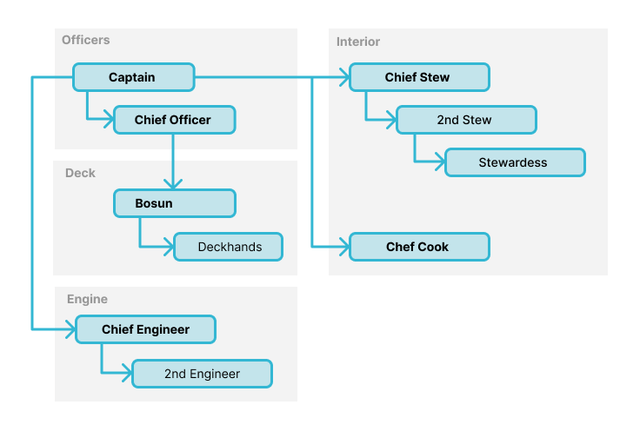
The Captain is in command and ultimately responsible for the safety of all guests, crew, the vessel and prevention of pollution. The Chief Officer is responsible for the deck and safety operations, and deputises for the Captain. The Chief Engineer is responsible for all machinery, equipment and environmental compliance. The Chief Stewardess is responsible for the interior and guest care. The Chef is responsible for the galley, catering and food hygiene. Every crew member should respect and follow the directions of their head of department.
4. Safety
The Captain bears overall responsibility for all incidents on board. By delegation, every crew member must know and follow safe working procedures.
Safety Management System. The yacht operates under an [mini-ISM-compliant] or [ISM] safety management system comprising checklists, procedures and reports. Crew shall use these tools for all operations. A Safety Training Manual is provided to all crew members in the crew mess and must be read within the first week on board. Questions should be directed to the Safety Officer, Chief Officer or Captain.
Drills and training. The yacht conducts drills on a regular basis. Participation is mandatory for all crew regardless of department, seniority or workload. Safety induction must be completed within the first 24 hours of joining.
Personal Protective Equipment. The yacht provides PPE to prevent accidents and reduce the severity of injuries. All crew must use PPE correctly and be trained to do so.
Permits to work. Specific jobs require a Permit to Work. These are mandatory, valid for 24 hours only, and must be re-issued daily.
Material Safety Data Sheets. MSDS records are maintained on board and available from your Head of Department. In case of intoxication or harm from a product, report immediately to the medical officer and identify the product involved.
4.1 Tenders, Cranes and Hydraulic Equipment
Hydraulic apparatus — including cranes, tender cranes, shell doors, capstans, anchor windlass, beach doors, rescue doors, lateral gangways and aft gangway — may only be operated by the engineering team or officers unless the Captain or Chief Officer has specifically authorised and trained an individual.
Tender operations:
- Tenders with guests: minimum 1 driver and 1 deckhands.
- A solo driver must wear a lifejacket and be connected to the kill cord at all times.
- Permanent radio contact with the Officer of the Watch is mandatory. All movements, departures, arrivals and changes of plan must be reported to the bridge immediately.
Authorisation to drive tenders is granted individually by the Captain or his deputy after verification of official qualifications, a personal assessment and knowledge of yacht procedures. The Captain remains fully responsible for the actions of all tender drivers, and collision regulations and local laws apply.
4.2 Driving Yacht Vehicles
Drivers must obey local laws and check the vehicle's condition before use. Speed limits must be observed at all times with due consideration to weather, visibility and road conditions. Unless following a direct order from the Owner, the driver is personally responsible for any fines incurred.
5. Social Behaviour Policies
5.1 Mobile Phones and Communications
Personal mobile phones must not be used in the vicinity of guests or while on duty, except for yacht-related calls. All crew are issued a radio — it is a professional tool and transmissions can be heard by Owners, Guests and people outside the vessel.
Radio discipline:
- Keep transmissions short, correct and professional.
- On charter, use an earpiece at all times; radio conversations must not be heard by Owners or Guests.
- For extended discussions, agree a meeting point over the radio and continue face to face, or switch to an appropriate channel.
5.2 Internet
Internet is provided primarily for Owners and Guests. Crew receive access to a dedicated Wi-Fi network. Usage of any other on-board Wi-Fi network is strictly forbidden. No downloading, peer-to-peer applications or video streaming (YouTube, Netflix) is permitted. Messenger-type applications may be used without video sharing. Crew internet access may be restricted during charter periods.
5.3 Discretion and Social Media
Crew must not publish any information about the yacht's activities on social media or elsewhere. This includes but is not limited to: Owner or Guest names, images or personal information; the yacht's name, location or images where it can be identified; crew photos showing the yacht's name on uniforms; and any details of itineraries, destinations or ETAs. Posts that could be disgraceful to the yacht, Owners, Guests, crew or management company are also prohibited.
The Captain recognises the excitement of the yachting lifestyle, but every crew member has a duty to protect their employer's privacy and security. Heads of Department must monitor their team's social media. Any critical breach requires immediate removal of the post and may result in dismissal.
6. Crew Decorum
Crew must maintain a neat and tidy appearance at all times. Uniform must be clean, pressed and in good repair. Chewing gum is forbidden on charter and around guests. No flashy jewellery or visible piercings (except one earring per ear) while on charter. Male crew must shave daily before starting work. Overpowering fragrances should be avoided; light, quickly-dissipating scents are acceptable.
Sunglasses should be removed when speaking with Owners, Guests or visitors. Non-interior crew must remove shoes before entering guest areas. Uniform standards may be relaxed during refit and maintenance periods. The Captain's word is final on all matters of uniform and appearance.
Uniform management. The Chief Stewardess issues all uniform sets. Work uniforms remain the property of the yacht and must be returned on departure. Crew must hand in uniforms for laundering daily — no hoarding. Older uniforms should be worn for dirty maintenance tasks. Protective overalls, gloves and booties are available when needed.
Off-duty dress. Crew must maintain a dress standard consistent with the yacht's standards while on board or entering and leaving the vessel. If in doubt about whether attire is acceptable, it probably is not.
Laundry. The interior department launders all crew work uniforms daily. Crew must deposit uniforms by the end of each workday or before 08:00 the next morning. While Owners or Guests are on board, no personal laundry is permitted except undergarments and sleepwear. Only designated interior crew may use the laundry facilities.
7. Crew Living Quarters
Crew mess. All crew are responsible for keeping the mess clean and tidy. Clear away personal items, wash and stow all food-service ware immediately after use, and carry out any domestic duties assigned during your watch.
Cabins. Crew sharing cabins must be considerate regarding cleanliness, noise and shared facilities. Open flames, candles and incense are strictly prohibited. No handmade electrical installations or alterations are permitted; all appliances must be unplugged when unoccupied. No screws or nails may be driven into bulkheads or furniture. Cabin changes require the Captain's permission.
All crew must keep their cabin clean and tidy, make their bed each morning before work, launder bed linen weekly, and air bedding monthly. The Captain reserves the right to inspect cabins with prior written notice; occupants may be present. Cabins that do not meet cleanliness standards must be cleaned on the occupant's own time. Personal belongings must fit within allocated storage; excess items must be shipped home at the crew member's expense.
Meals. All meals are provided at the yacht's expense and must be eaten in the crew mess. Standard meal times: breakfast self-service (cleared by 07:55), lunch at 12:00, dinner at 19:00. These may vary during charter periods. Crew not eating on board must sign the list by 10:00.
No crew may take food from Owner/Guest refrigerators, pantries, bars or stores without permission from the Chef or Chief Stewardess. Doing so constitutes theft and is grounds for immediate dismissal. After meals, crew must clean all cookware and utensils used and stow leftovers in crew refrigerators.
Beverages. The interior crew stocks the mess refrigerator. Crew are expected to exercise moderation. The yacht provides drinkable water without restriction. Taking beverages from Owner/Guest stores constitutes theft and is grounds for immediate dismissal.
8. Working Arrangements
8.1 MLC Hours of Work and Rest
The yacht complies with the Maritime Labour Convention (MLC) requirements on hours of work and rest:
- Maximum 14 hours work in any 24-hour period; maximum 72 hours in any 7-day period.
- Minimum 10 hours rest in any 24-hour period; minimum 77 hours in any 7-day period.
- Rest may be divided into a maximum of two periods, one of which must be at least 6 hours. Two consecutive rest periods must not be separated by more than 14 hours.
Working schedules are posted in the crew mess corridor. The Captain may suspend normal schedules in emergencies or to maintain guest service levels and vessel safety. On return to normal conditions, compensatory rest will be provided to prevent fatigue build-up. Overtime entitles crew to compensatory rest but not additional monetary compensation.
Each crew member must maintain their monthly hours-of-work-and-rest log on DeepBlue©, print, sign and submit it to the Chief Officer by month-end. Officers on navigational and engine watches must have their rest periods respected — all crew should minimise noise in crew corridors accordingly.
8.2 On-Charter Schedule
All crew work every day and evening while Owners or Guests are on board. Break times are scheduled but not guaranteed. Heads of Department will provide rest periods when possible; crew should use them effectively as the next break cannot be guaranteed.
Breaks ashore during charter. May be authorised by the Captain and approved individually. Crew must maintain the highest standards of decorum, wear clean uniform, and maintain radio and phone contact. Alcohol consumption must be minimal. Misbehaviour during shore breaks will result in immediate dismissal.
8.3 Off-Charter Schedule
| Monday to Friday | |
|---|---|
| 07:00 | Breakfast |
| 08:00 – 12:00 | Ship's work (15 min break around 09:45) |
| 12:00 – 13:00 | Lunch |
| 13:00 – 17:00 | Ship's work (15 min break around 15:30) |
| 19:00 | Dinner |
| Weekends | Ship's work if required; otherwise liberty for all hands not on duty |
The 08:00 start is mandatory. Crew must report sober, clean and well-rested. The working day usually ends around 16:30 depending on projects and schedule. In the final 15 minutes, all tools and equipment must be returned to their proper storage, work areas cleaned, hatches closed, and all areas cleared of hazards.
When the yacht has no scheduled Owner or Guest use for more than two weeks, the Captain will endeavour to provide two consecutive days off per week.
Breaks ashore off-charter. Breaks are limited to 15 minutes. Crew must sign out and back in, and have department head approval.
Off-duty crew ashore while on duty. Must remain within hearing distance of alarms and be available for the boat phone. No more than a few metres from the gangway and no more than five minutes. For yacht business ashore, inform the Captain and/or watch officer and provide an expected return time. Sign out and back in.
Shore leave. Crew intending to go ashore must log out on the in/out board. Those sleeping ashore must inform the watch officer and provide a working phone number. Crew whereabouts are essential for emergency response or impromptu sailing orders.
8.4 Watch Systems
24-hour watch. Off-charter watches run 08:00 to 08:00 on a rotating basis, scheduled by the Chief Officer and posted in the crew mess (also available on DeepBlue©). Watch crew must be awake, sober and in proper uniform by 08:00, and remain alert until at least 22:00. Watch exchanges require prior approval from the Chief Officer and/or Chief Stewardess.
Watches at sea. Deck and engineer crew maintain a full 24-hour watch. The navigational watch must be maintained by a deck officer at all times. During night periods or reduced visibility, an officer and a deckhand are required; the deckhand must conduct hourly exterior rounds. Night watch schedules are published daily by the Chief Officer. If the vessel is UMS-classified, engine watch keepers must remain awake and alert where alarms can be heard. Falling asleep during a watch is grounds for immediate dismissal.
Watches at anchor. A full watch system is maintained. Night watches include hourly position verification using radar, maintaining the navigational logbook, displaying appropriate day-shapes and lights, organising crew transport ashore, and monitoring VHF/UHF radios. During the day, the stern must never be left unattended when guests are using the swim platform or water toys. At least one deck crew member must be present and vigilant at all times. Swim platform watch keepers must not leave until properly relieved.
Watches in port (on charter). The gangway must be attended at all times by the deck team. Guest movements must be broadcast on crew radios — interior department first, then deck. No unknown visitors may board without authorisation from the Owners, Guests, Captain or an officer. The interior team should be informed promptly when guests approach or leave, to prepare welcome service and enable housekeeping. A guest on/off status must be maintained and communicated at watch relief.
8.5 Watch Duties
All crew must be trained and capable of executing basic safety and security functions, including responding to fire detection and bilge alarms. In an emergency:
- Assess whether the incident can be handled with available equipment.
- Never endanger your life. If conditions are perilous, sound the alarm and evacuate. Call the local fire brigade immediately.
- Contact local authorities and nearby vessels via phone, VHF or continuous short blasts of the yacht's horn.
- Operate fire pumps, bilge pumps and manifold valves as required.
- Isolate electrical power and ventilation to the affected area.
- Activate engine room fire suppression if necessary.
Deck watch duties focus on safety, fire prevention and security. Log entries must record all Owner/Guest arrivals and departures, visitors, incidents, and other relevant information. Routine duties include: managing exterior and interior lighting, raising and lowering the flag (08:00/sunset), conducting interior inspections at 08:00, 13:00 and 18:00 (in clean socks when entering guest areas), exterior inspections of decks, mooring lines and fenders, monitoring weather, answering the yacht's phones, and activating the security alarm before retiring.
Interior watch duties include inspecting guest and service areas, ensuring lights are off and doors closed in unused spaces, washing and storing all food-service ware, managing crew mess rubbish and cleanliness, and maintaining phone and alarm awareness.
Engineering watch duties include operating bilge pumps and manifolds, managing grey and black water tank levels, and switching fresh water system pumps.
9. Security
Keys. All keys and fobs must be returned to the Captain or Chief Officer on departure, including cabin keys, master keys and work area keys.
Visitors. The yacht's security level must be maintained at the highest standard:
- All visitors must be escorted by a crew member at all times.
- A visitor log must be maintained (name, company, date, time in/out). Visitor badges should be issued.
- Access may be refused to anyone without photo identification.
- Visitors should remove shoes on deck and in the interior (exceptions: officials in uniform where shoes are required, and workers requiring safety shoes — shoe covers will be provided).
- Officials must be escorted directly to the bridge and left only with the Chief Officer or Captain.
- Crew may not invite personal guests without the Captain's permission.
- No parcels or deliveries may be brought on board without prior authorisation and inspection by the appropriate Head of Department or Chief Officer.
Guest areas. Crew may only enter guest areas on legitimate duty. The Chief Stewardess or 2nd Stewardess must be informed before and after any work in guest areas. The guest elevator and staircases are out of bounds to non-interior crew except when absolutely necessary.
10. Misconduct and Disciplinary Procedures
10.1 Immediate Dismissal
The following acts warrant immediate dismissal, and may also result in legal action. The yacht assumes no obligation to repatriate guilty crew or pay outstanding leave or severance:
- Assault (physical or verbal, including towards objects), intimidation or coercion of crew
- Possession, purchase, sale or use of illegal drugs or misuse of prescription drugs, on or off the yacht
- Consumption of alcohol while on duty, underway, while Owners or Guests are on board, or while operating vehicles, tenders, machinery or firearms
- Possession, purchase, sale or trafficking of contraband
- Graft: accepting or giving bribes, kick-backs, fees or commissions while conducting yacht business
- Actions or speech bringing the yacht, Owners, Guests or crew into disrepute
- Critical, demeaning comments about the Owners, Guests or crew, including to persons outside the yacht
- Passing false statements about the yacht's operations, Owners, Guests or crew
- Intentional damage to the yacht or any property on board
- Repeated failure to carry out duties or reasonable requests from the Captain or officers
- Theft or possession of stolen property
- Actions impeding a voyage or compromising the safety of the vessel or persons on board
- Sleeping on duty or leaving an assigned post when this compromises safety
- Causing unauthorised persons to be on board
- Smoking or using naked flames near dangerous cargo, stores or during bunkering operations
10.2 Warnings and Reprimands
Lesser misconduct — including malingering, negligence, poor work performance, lateness, offensive behaviour, reporting to work hung-over, or leaving duties early — warrants progressive discipline:
- Informal verbal warning from a department head or the Captain
- Formal verbal warning, recorded and reported to the Captain
- Formal warning from the Captain, witnessed by an officer
- Written reprimand, recorded in the yacht's logbook with a copy to Ownership/Management
Any formal warning or reprimand will be followed by written notice of the consequences of further misconduct.
11. Smoking, Drugs and Alcohol
Smoking. The Owners have expressed a preference for no smoking on board. Smoking is permitted on the dock during sanctioned break times only. On charter, crew may smoke on the quay out of view of Owners and Guests during breaks. Crew must not smell of smoke during working hours.
Drugs. The purchase, possession, sale or use of illegal drugs on or off the yacht is grounds for immediate dismissal. The yacht will conduct random drug testing; refusal to submit constitutes an admission of use. All crew have a duty to report suspected drug use immediately. Drug offences ashore can result in seizure of the yacht and incarceration of all on board.
Alcohol. Alcohol is not permitted while on duty (including 24-hour watch), while the yacht is underway, or while Owners or Guests are on board. While off duty and off charter, moderate consumption of beer or wine is acceptable — the yacht is never to be used as a platform for getting drunk. The yacht provides a modest monthly allowance of beer and wine; spirits must be purchased personally ashore.
Reporting for duty hung-over is unacceptable and dangerous. One warning will be issued; a second offence results in dismissal.
12. Prohibited Activities
Contraband. Crew must not purchase, sell or traffic in contraband of any kind, or associate with people or activities connected to contraband.
Graft. Any form of bribery or kick-back while conducting yacht business is prohibited. Where vendors offer cash refunds, these must be shown as credits on the invoice. The Captain has zero tolerance for this practice and will pursue legal action where possible.
Weapons. No firearms, shock devices, knives (other than work tools) or personal weapons may be brought on board. Personal protection items (mace, pepper spray) may only be carried off-duty, off the vessel and in compliance with local law, and must be checked in with the Captain or Officer in Charge on return.
13. Reporting Obligations
Any breach of these standing orders, particularly concerning misconduct, harassment, drugs, alcohol or prohibited activities, must be reported to the Captain or Officer in Charge as soon as possible. This includes: incidents involving authorities, damage to the yacht, theft or loss, sickness or injury, and harassment or bullying.
In the event of illness or injury, inform the Captain or Officer in Charge before seeking medical attention when possible, and retain all medical reports and receipts.
All reports are treated in strict confidence. Retaliation against anyone who reports violations or cooperates with an investigation will not be tolerated. Knowingly failing to report a breach is itself grounds for dismissal.
14. DeepBlue© Software
DeepBlue is the yacht management software used on board. All crew members have individual access and are required to use it for crew details, HRM, hours of work and rest records, leave and holidays, maintenance and safety, accounting and charter operations, and vessel conformity and ISM records.
15. Revision History
The Master is responsible for ensuring the latest version of these standing orders is available on board.
| Version | Date | Editor | Revision History |
|---|---|---|---|
| 1.0 | 06 Mar 2020 | Christophe Guegan | Initial Commit |
| 2.0 | 11 Apr 2026 | Christophe Guegan | Rewritten for clarity and conciseness; no substantive changes |
Risk Assessment — Additional Passengers: Events at Anchor
Pre-populated risk assessment for the carriage of additional passengers on M/Y WAVE during static charter events at anchor or on a river buoy, in accordance with CIGN 2025-06.
Chief Engineer
Standing orders issued by the Chief Engineer governing watchkeeping, maintenance, safety and MARPOL compliance in the engine department.