

PWC Training Manual
The PWC Training Manual provides the procedures and recommendations to ensure the safety of guests undertaking courses and using Personal Watercraft (PWC) onboard.
| Yacht Name | M/Y --- | Shipyard | |
| Flag | Port of Registry | ||
| Revision | 1.2 | Date of issue | 10 Dec 2023 |
| Gross Tonnage | Date of Keel Laying | ||
| Company | Yachting Concept Monaco | Office Number | +377 99 90 16 30 |
| Director | Thierry Roux | ||
| Designated Person | Christophe Guegan | 24/7 Phone | +377 99 92 36 48 |
| Company approval | RO approval | ||
| Date | Date |
This plan has been developed for M/Y Vessel Name and is valid until further revision.
1. Definitions
| Terms | Definition |
|---|---|
| ACCIDENTS | When injury to individuals has occurred, or damage has occurred to the yacht or its equipment |
| RYA | The Royal Yachting Association is the national association for dinghy, yacht and motor cruising, all forms of sail racing, RIBs and sports boats, windsurfing and personal watercraft. |
| PWC | Personal Watercraft A.K.A. Jetski |
| PWI | Personal Watercraft Instructor |
| PFD | Personal Floating device |
2. Introduction
The yacht as a recognised RYA personal watercraft training centre
Personal Watercraft (PW) are exciting, relatively easy to use and quite intuitive to learn to drive. They are popular at both inland and coastal locations and there are many different ways to try your hand at riding one. However, in most locations, a valid licence is required by law to operate a PWC (AKA Jetski).

The yacht could be officially recognised as an official RYA personal watercraft training centre, and therefore able to deliver temporary licences to allow guests to drive our Jetski during their charter time after an introduction to the PWC safety course.
Personal Watercraft (PW) Instructors are experienced PW drivers who have been trained and assessed to run the RYA's Personal Watercraft Proficiency Course and the Introduction to PWC Safety course, which is for guests on Superyacht charter holidays.
The objective of this document is to ensure that the onboard RYA PWC training and operations onboard are run safely at all times. The procedures and recommendations will ensure the safety of those undertaking courses and using PWC in addition to other water users and crew.
3. Responsibilities
The captain and by delegation the first officer will oversee all operations onboard involving PWC usage and training. He is responsible for the safe operation of the vessel and will have the final decision regarding the usage of PWC by the guests and crew members. The captain will ensure that a qualified RYA PWC instructor carries out all training.
The PWC Instructor onboard will conduct all operations onboard involving PWC training and delivers RYA licences. He is responsible for the safety training of the guests and other crew members.
The instructor:
- familiarises the guests with Jet Ski,
- teach them how to operate safely and with consideration to others ashore and afloat,
- checks on local weather, underwater obstructions, local hazards, local regulations, and anything else concerning the area that the guests will explore.
All guests should be competent swimmers and be confident in the water with a buoyancy aid on.
Once the induction is complete and Safety Briefing Form is signed the guest will understand their responsibilities on the water.
It is also recommended that guests wear a wetsuit, gloves, goggles and protective footwear.
4. Safety
The PWC Instructor is in charge and responsible for the safety of all guests as well as crew during the period of the training/assessment as well as after the course.
- All PWC usage is always regulated by local laws. The instructor must be aware of the regulations before any PWC is launch into the water.
- All crew using PWC's must hold an RYA PWC Proficiency certificate or RYA Introduction to PWC Safety certificate or equivalent certificate.
- The RYA PWC instructor can only run the RYA introduction to PWC safety course for superyachts.
- Once training is complete, should the PWs leave sight of the mother vessel, supervision will be done via the tender, driven by a crew member.
- The instructor or appointed person will ensure that all relevant crew are informed about who is on the water (PWC and tender) at all times.
- The minimum age for a PWC user is 12 and must be onboard with a guest over 18 years old, or a member of the crew who holds RYA PWC Proficiency.
- Pollution of beaches, banks and the water from oil and rubbish is a MARPOL offence. When fuelling care should be taken to ensure that fuel and oil are not spilt into the environment.
- Wildlife may be vulnerable if it is disturbed. PWC users should be aware of any sensitive areas and keep well clear of them.
Additional responsibilities after use
- Rinse buoyancy aids with fresh water then hang to dry.
- Rinse the PWCs with fresh water.
- Flush Jet Ski with fresh water and refuel if needed, do not let fuel level go below half a tank.
- A full general inspection of the Jet Ski must be carried out after each use. Report all defects.
The instructor will assess and ensure that:
- The safety boat and equipment are appropriate and ready for emergency rescue at all time;
- All crew members involved in the operations of PWC’s are properly briefed;
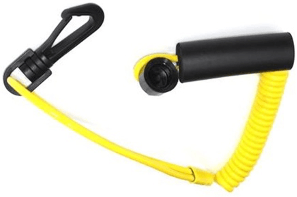
- Kill cords must be fully functional, clipped and used at all times when the PWC is being used afloat;
- The operating areas must be taken into account as well as the distance each PWC can travel from the mother ship. All prevailing conditions must be taken into account;
- Use of helmets is NOT optional: each rider must wear one of the appropriate sizes. When two or more people are riding the PWC’s, it is even more important that all riders are wearing a helmet;
- PFD (Personal Flotation Device) must be worn at all times when the PWC is underway;
- Anyone under the age of 18 must be considered as a child for this document;
- Children under the age of 16 must be a passenger to a qualified member of the crew or a responsible adult guest;
- Find out from local authorities to gain local regulations.
Safety briefing
- Explain local risks and laws to all guests;
- Explain what operating area they will be allowed to use;
- Ensure all PWC users are aware of slow speed zones at all times;
- Ensure all PWC’s stay 300 meters from the shore;
- Ensure that all PWC’S stay at least 150 meters from any other vessel;
- Keep a very good lookout for swimmers and other water users;
- Ensure that any relevant medical conditions have been declared to the captain before use of PWC;
- Highlight the importance of wearing a helmet and personal floating device;
- Highlight the importance of wearing the kill cord at all times and where to attach;
- Emphasise that safety is the most important issue when operating PWC’s alone;
- Smoking on board a PWC is STRICTLY FORBIDDEN;
- Ensure that the safety boat has good two-way communications with the mother ship at all times.
5. Guests Training Syllabus
5.1. Introduction to PWC Safety
The captain is responsible for the safety and quality of all training onboard, however, the instructor will ensure teaching to RYA standards on a day-to-day basis. Good training demands that good teaching methods are delivered on appropriate equipment with a student/instructor ratio of up to 3. A flexible teaching approach to ensure that this can be delivered to correspond to the guests’ needs.
Guidance notes and syllabus for the ‘Introduction to PWC Safety course for PWC operations
- The minimum age is 12
- The ratio must not exceed one instructor to three PWC’s with no more than two per watercraft
- Ability after the course to operate a PWC in good conditions whilst UNDER SUPERVISION
- The minimum course duration is 1 hour. (The full PWC course or an assessment is subject to the instructor discretion, this will be based on a case-by-case evaluation)
5.2. Course content and syllabus
- Instructor’s checks
- Essential safety information
- Operating area
- Collision avoidance
- Rules of the road
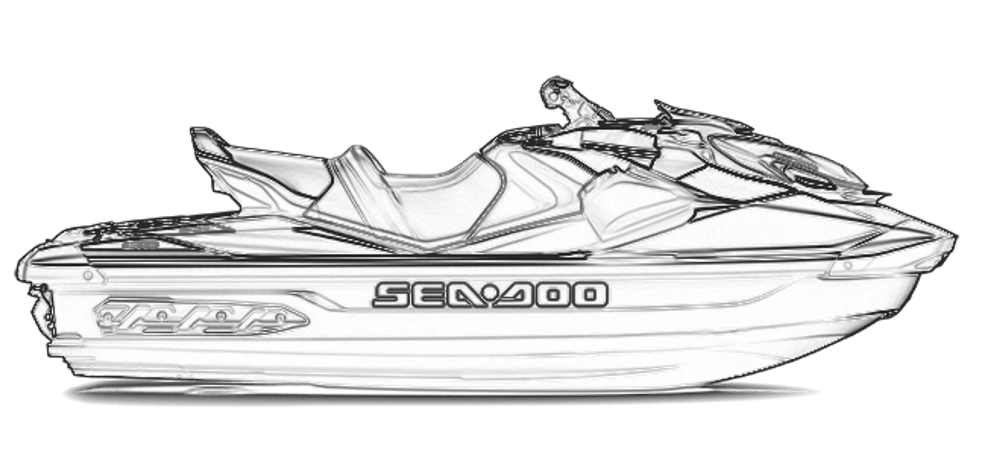
- Layout of the PWC
- Controls, propulsion and steering system
- Personal safety equipment
- Essential safety information, kill cord, speed limits, safe working speeds, local hazards, etc.
- Practical control, slow and high speed
- Re-boarding in deep water
- Local hazards and regulations
- Communications with the safety boat
All of the subjects above will be taught following the same syllabus as for the PWC Proficiency course as laid down in the RYA Personal Watercraft Handbook (G35). Introduction to personal watercraft.
5.3. Instructors to check
- Previous experience of the guest using PWC
- Reason for the required qualification
- Duration of the training (i.e. a full course or just an assessment only)
- Personal safety equipment:
- Buoyancy aids, explain how to wear the floatation device, explain the reason why it has to be a snug fit. Explain impact protection, warmth and buoyancy
- Kill cord, explain why they should be shown, and how to attach the kill cord to the PWC rider and explain why they should be attached at all times.
- Helmets, reason to wear and how to use. A large choice is available in different sizes.
5.4. Essential safety information
- Explain appropriate safe speed, discuss what to do if other craft come into their vicinity and reiterate that a good helmsman will always slow down
- Discuss the need for PWC’s to be considerate to other water users
- Communicate operating areas
- Maintain a good lookout at all times when stationary as well as underway
5.5. Operating area
The yacht will move to different operating areas due to the nature of the industry. This means that all PWC users will have to be kept up to date with local regulations. Before commencing training, the captain and instructor will be fully aware of the local regulations.
- The instructor in charge of the session will identify the training area to be used.
- The operating areas should be free of hazards.
- Other hazards should be identified and all guests made aware of their existence.
- The training area used to deliver the RYA Introduction to Personal Watercraft Safety will be within sight of the designated operating area or vessel.
- The PWC operations will only take place from the swim platform. If the operating area is in a busy anchorage or out of sight of the mother ship permission to operate must be granted from the captain. If one or both PWC’s are being used or the area of operations is out of sight of the mother ship, the rescue boat will accompany the PWC’s at all times.
5.6. Collision avoidance
- Explain collision regulations, you may have to use visual aids if the student finds it easier to understand
- Treat all vessels as the same, they will all follow the same collision regulations
- Give a clear indication of how far you must keep from other water users
- Explain the need to deduce speed when needed for safety or coming alongside the swim platform
5.7. Collision regulations
- It is extremely important to know what to do if a collision looks likely
- Lookout: Keep a proper lookout at all times, 360 degrees around you
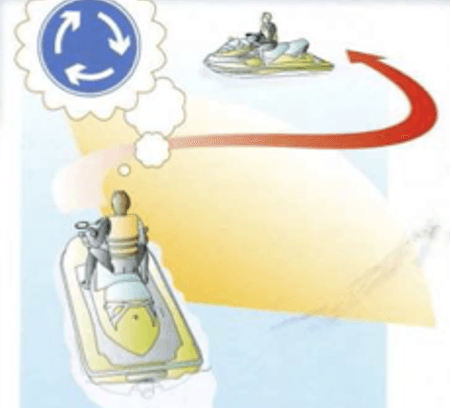
- Head on: Always turn to the right – It must be early and obvious
- Crossing situation: Give way to traffic coming from your right. If traffic coming from the left, stand on with caution and continue at the same course and speed. Be prepared to take avoiding action
- Overtaking: In a clear seaway overtake on either side
- Safe speed: Vessels should maintain a safe speed for the prevailing circumstances
- Jet skis being more manoeuvrable than larger craft so the jet ski user should keep clear of all other vessels
5.8. Layout of a PWC
- A general overview of the PWC
- Open and explain what is stored in the watertight hatches
- Explain how to remove the seat to gain access to the engine
- Explain why the seat should never be removed whilst the PWC is on the water
- Explain the kill cord and demonstrate how it works, and how to reattach and what to listen for
5.9. Propulsion and steering system
- Explain how the throttle and braking system works.
- Explain how the steering works and demonstrate how this affects the water drive.
- Explain forward and reverse steering and that you always need movement through the water to achieve this.
5.10. Demonstrate
- Re-boarding in deep water
- Capsize and re-boarding
- Practical control at slow speed, reversing
If students are not confident or you are instructing children, the PWI can always sit behind the student with the kill cord attached to his wrist until the student gains confidence
5.11. Go afloat
- Get students to run slow speed S and U-turns, once they gain confidence repeat exercise but at a faster speed
- The student to experience a lack of steering without throttle
- The student to experience stopping distance when the throttle is removed at speed
- Students must note and remember the distance experienced
- Students will then have a competition to stop using this method. Closest to the marker buoy is the winner
Some guests will discuss that they are experts on PWC’s and does not need to undertake a safety course. In these situations, the PWI can agree that whilst perhaps they do not need a full course, they will still have to have their skills assessed.
The instructor at this stage runs the assessment questioning the user (or users) on all of the areas that would have been covered on a full PWC safety course. In doing so, he is running the course but is presenting it differently. In this way, he can address gaps in the user’s knowledge and any skill fade that is present. The guest will still get a complete course when they thought it was an assessment.
5.12. After course and assessment guidelines
The certificate holder will only be able to operate personal watercraft under the direct supervision of the instructor on board the yacht that issues the certificate. Supervision will be either from a safety boat or tender or from a suitable point overlooking the area of operations. The certificate will only be valid for the duration of the charter as indicated by the expiry date on the certificate
Should the holder of this certificate subsequently wish to use PWC’s from another superyacht, if it is an RYA training centre the captain should satisfy himself or herself that the user has received suitable training and issue a new certificate under the RYA guidelines.
All certificates should be available for inspection by relevant authorities and should be held by the PWI for those PWC users on the water. A scanned copy of the certificate will be uploaded in DeepBlue© and keep for authorities’ inspection. The captain and PWI must always cover an on-board assessment session regardless of previous qualifications.
Supervised activity will take place in an indicated area under direct supervision by a qualified crew.
Upon completed the basic introduction, the users will be issued the following certificate signed by the captain.
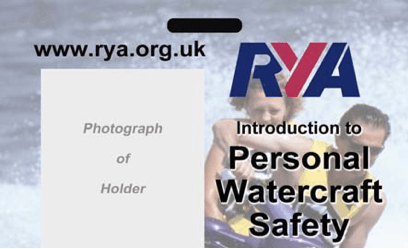
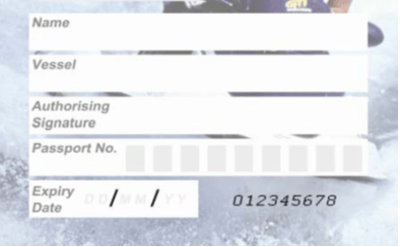
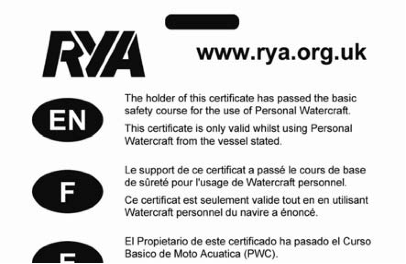
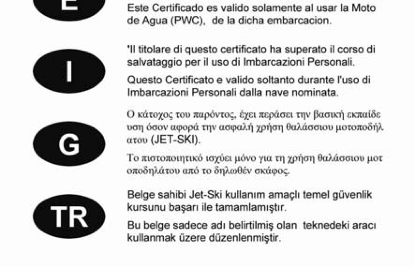
- Photograph required
- The expiry date for Charter Guests will not go beyond the charter period
- The expiry date for Regular Guest and Owners will not go beyond the charter duration
- The expiry date for all crew will not go beyond 9 months
- The principal will sign the certificate
- A passport number is required for international validity
- The RYA certificate number identifies which yacht the certificate is issued to
- The Certificates issued must be retained by the school
6. PWC usage policy
At all times, a tender will be afloat to monitor and provide assistance to all PWC activities. Kill cords, helmets and PFD are to be worn to all PWC user, guests or crew. There will also be a visual lookout at all times maintained by one of the deck department.
The PWC can be used with 2 keys:
- The Green key is for reduced power and should always be given to new drivers, kids or in case of crowded usage area.
- The Yellow key which allows maximum PWC power can only be given to ADULT guests with experienced that has been verified by the PWC instructor.
6.1. Embarkation
- Embarkation and disembarkation will be done from a floating platform.
- Crew members will always assist guests to embark and disembark by holding the PWC alongside the floating platform.
- If multiple users want to embark, always start with the adult or the heavier.
- Crew members will make sure that the guests properly wear PFD and helmet.
- Crew members will connect the kill cord to the guest's PFD.
- Once the engine has been started and the area of PWC operations have been reminded to PWC operator, the crew member will have a look at the surrounding area clear of swimmers and other potential hazards.
- Once all the above have taken place and the PWC user is happy, then the PWC will be allowed to leave the swim platform.
6.2. Recovery
- The PWC will touch back always against the floating platform, and never against the swim platform to avoid the PWC going under the platform, causing potential physical accident and damage to the hull and the PWC.
- When the PWC is ready to be recovered, the PWC user will approach at the slowest speed the floating platform against the wind (generally the same direction of the mother vessel).
- Crew members will monitor the swimmers and other toys around. If the situation is clear, he will allow the PWC to touch the platform.
- As soon as the crew member holds the PWC, the engine should be stopped immediately by pulling the kill cord.
- When the engine is stopped and the PWC is secured against the platform, the user can disembark with the help of the crew member.
- If multiple users have to disembark, always start with the child or the less heavy.
- The crew member helps the guest to remove PFD and helmet only when it is safe to do so.
7. Actions in case of an accident
PWC are powerful machines capable of travelling at high speeds. They are frequently ridden by inexperienced riders with little or no knowledge of the “rules of the road,” and serious injuries and death can and do occur. The commonest cause of injury is a collision with another vehicle. There are generally orthopaedic injuries that are consistent with high-speed collisions. the injuries can then cause drowning if the casualty is not immediately rescued.
Many preventative measures can be taken to reduce death and injury rates, including proper training of users and wearing correct protective devices.
At all times, PWC activities will be monitored by one of the deck department members not assigned to any other duty. If the PWC is out of sight of the main vessel, it should be supervised by the tender with at least 2 crew members.
In the event of an accident:
- Call immediately the bridge and inform the captain or the officer on duty.
- The tender (with 2 crew member) must reach the casualty as soon as possible
- Secure the PWC user out of the water, onto the tender or the swim platform
- Don't remove the helmet and keep the PFD
- Place the casualty in the lateral safety position (PLS)
- In the meantime, the available crew will
- Stops all other water activities
- Keep the swim platform clear of other guests, equipment and prepare to recover the casualty.
- Bring the first emergency kit and stretcher to the swim platform
The captain/Safety Officer will then:
- Follow the emergency checklist for medical emergency
- Call local authorities / Coast guard / MRCC
- Require the help of the DPA
- ISM Accident report will be initiated
- RYA will be informed of the accident
8. Child protection policy
Anyone under the age of 18 years should be considered as a child whilst on board. The yacht accepts children of 12 and over onto the RYA Introduction to Watercraft Safety course.
At the discretion of the captain, children under the age of 12 years old can go on a PWC as long as they have a qualified adult who has completed the PWC safety course or a qualified RYA PWI with them at all times whilst on the water.
Whilst onboard the yacht, the sole responsibility for the child is down to the parents or the responsible adult, the primary role of the crew is the safety of the yacht and guests, not to be responsible for the guest children.
Policy statement:
- The child’s welfare is paramount whilst onboard the yacht.
- All children whatever their age, culture, disability, gender, language, racial origin, religious belief and/or sexual identity, have the right to protection from abuse.
- All suspicions and allegations of inappropriate behaviour will be taken seriously and responded to swiftly and appropriately by the captain and shore authorises.
- The captain will only allow Instructors to work solely with children that they already know and thus trust.
Good practice for instructors:
- During a course and for your protection, a situation need not and must never arise where the child is in your sole care.
- Only allow the parents or nannies to photo or film children during water activities or when asked to directly by the parents or nannies.
9. Launching and recovery PWC procedures
| # | PRE-LAUNCH | ✔️ |
|---|---|---|
| 01 | Ventilate engine compartment for 5 minutes | |
| 02 | Deck lashing removed | |
| 03 | Petrol level checked | |
| 04 | Oil level checked | |
| 05 | Hull bungs closed | |
| 06 | Kill cord key in position | |
| 07 | Engine start for 1 second | |
| 08 | Lanyards checked in position |
| # | RECOVERY | ✔️ |
|---|---|---|
| 09 | Hull rinsed with fresh water | |
| 10 | Engine rinsed with fresh water | |
| 11 | PWC in position secured with deck lashing | |
| 12 | Bungs opened | |
| 13 | Engine ventilated and sprayed with moister protector (WD40) | |
| 14 | Gas topped up |
| # | WEEKLY MAINTENANCE | ✔️ |
|---|---|---|
| 15 | Oil level checked | |
| 16 | Coolant level checked | |
| 17 | Safety equipment checked (hand flares, extinguisher, towing line) | |
| 18 | Water system cleaning with salt remover |
10. Safety Briefing Form
All guests requesting to use the PWC’s (Jetski) to read, understand and sign this form
| # | PLEASE ENSURE THAT | ✔️ |
|---|---|---|
| 01 | Your instructor has given you the correct clothing; including: | |
| Life vest or buoyancy aid | ||
| Helmet | ||
| Goggles that it fits correctly | ||
| 02 | Your instructor has given you the appropriate training to use a PWC or | |
| You can show proof of valid training certificate or | ||
| You did demonstrate to your instructor your ability to use a PWC safely | ||
| 03 | You fully understand the age restriction of 18 (or 12 with an adult) | |
| 04 | You fully understand the use of the power throttle, the reverse throttle of the PWC | |
| 05 | You fully understand the importance and usage of wearing the kill cord | |
| 06 | You fully understand that there is a restriction of 300 metres from the shoreline | |
| 07 | You fully understand the local regulations | |
| 08 | You fully understand that you must NEVER pass in front of an oncoming vessel | |
| 09 | You fully understand that if you meet an oncoming vessel, you must turn to the right | |
| 10 | You fully understand that if you pass close to or stern of any vessel, you should proceed SLOWLY | |
| 11 | You fully understand that you MUST respect other yachts and swimmers | |
| 12 | You will return to the yacht as soon as requested by your instructor or captain if needed | |
| 13 | You are to the best of your knowledge, fit to use the PWC. If you are unsure, please ask the Medical Officer if any medical condition or other condition might put you or others at risk |
I have been given a safety briefing which includes the above list
Name: _______________________________ Date: _______________________________
Guest/Parent Signature: _______________________________
11. PWC Safety Cards
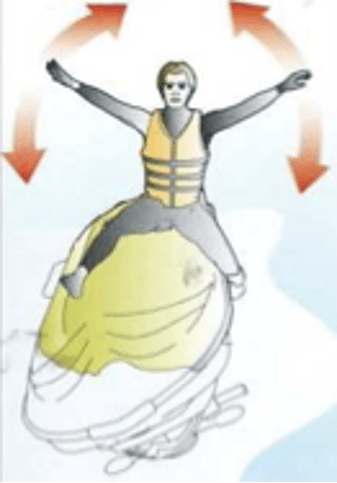
- Keep at all time, a proper all-around lookout
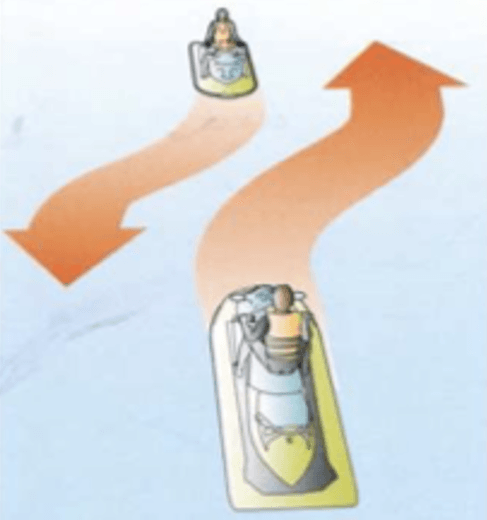 2. Always turn to the right if a collision looks likely
 3. You must give way to the right
4. Visual Distress Signal
12. Revision History
| Version | Date | Editor | Revision History |
|---|---|---|---|
| 1.0 | 06 Mar 2020 | Christophe Guegan | Initial Commit |
| 1.1 | 01 May 2021 | Christophe Guegan | Design and checklists |
| 1.2 | 10 Dec 2023 | Christophe Guegan | Transfert to Notion |