

Plans for Shipboard Operations
All yachts must adopt standard ways of working for shipboard tasks. These instructions represent minimum requirements and are not exhaustive. Refer to Appendix D for detailed reporting and handling requirements for documents required by this system.
Operations should be reviewed during the Master’s Annual Review, or sooner if circumstances dictate.
7.1 Standing orders
7.1.1 Master’s Standing Orders
The Master is responsible for the overall functioning of the yacht and must delegate and promulgate requirements for safe navigation and shipboard operations. The Master shall issue written Standing Orders to avoid ambiguity and to define where Officers’ and crew members’ authority ends and when the Master expects to be called. All crew must review and sign the latest Standing Orders.
7.1.2 Chief Engineer’s Standing Orders
The Chief Engineer has overall responsibility to the Master for all technical spaces, machinery, and equipment. The Chief Engineer shall issue written Standing Orders to engineering personnel defining required work standards and activities under their control. Engineering personnel must sign to confirm understanding.
7.2 Monthly Master’s & Chief Engineer’s yacht reports
Two reports must be completed monthly, one by the Master and one by the Chief Engineer. The Deepblue© portal contains controlled templates for both reports to ensure all routine actions and reporting items are covered. Submit both reports in Deepblue© each month. The Yacht Manager (YM), Designated Person Ashore (DPA), and Technical Manager (TM) will review and provide prompt feedback as necessary.
7.3 Completed drill schedule
To verify that all statutory drills have been conducted as required, the Master and/or Chief Officer shall maintain a log of drills in Deepblue© as a recurring task aligned to the drill schedule. At the start of each year, review and adjust the annual drill schedule to avoid peak operational periods (e.g., busy charter season). Additional requirements for entry into United States waters, including compliance with Non‑Tank Vessel Response Plan (NTVRP) regulations, are noted on the schedule.
7.4 On‑board health and safety reporting
7.4.1 Safety Committee
For yachts with five or more crew, a monthly on‑board Safety Committee meeting must be convened. The Master chairs the meeting. Members include the Safety Officer and elected Safety Representative(s).
- At the first safety meeting, provide crew the opportunity to elect a Safety Representative. Record the election in the Official Log Book, including the elected person(s) and term. The Safety Representative raises safety concerns from crew who cannot attend and ensures meeting outcomes are fed back to all crew.
- Use Safety Committee meetings to review health and safety prevention and improvement. Report to Yachting Concept Monaco using the “On‑board Safety and Security Committee Minutes” in Deepblue©.
- Invite all crew to attend where practical; otherwise the Safety Representative must cascade relevant information to non‑attendees.
7.4.2 Quarterly Safety Officer inspections
The Safety Officer must conduct a full inspection of the yacht every three months. Whether completed in one session or over the period, record completion on board.
- Raise and note any adverse conditions during Safety Committee meetings and report to Yachting Concept Monaco.
- Report serious deficiencies immediately in accordance with Defect/Reportable Item, Incident Report, or Non‑Conformity/Observation processes described in Appendix D.
7.5 Purchasing
Heads of Department, with the Master’s approval, are responsible for raising purchase requests to ensure the yacht is stored and equipped for safe and efficient operation while maintaining reasonable stock/spare levels. Complete request, order, and supply documentation accurately to avoid delays and missed deliveries. Document purchase requests where possible.
7.6 Deck Department
The Master and Senior Officers are responsible for implementing Standard Operating Procedures (SOPs) that define departmental operations, including voyages with and without guests.
- Conduct Fire Rounds in all accommodation at the end of each duty by the Watch Officer unless the area is manned by working crew. In port, ensure sufficient crew are available to provide minimum firefighting cover.
- Implement a Garbage Management Plan and, where applicable, a Ballast Water Management Plan.
7.6.1 Voyage planning
The Master assigns a nominated Deck Officer to plan passages and provides any special routing requirements. The nominated Deck Officer prepares the passage plan and submits it to the Master for approval. The Master authorises the passage plan by countersigning it and ensures the Engine Room is informed, especially regarding engine movements.
Before planning any passage, the nominated Deck Officer must gather information on the proposed route, including but not limited to:
- All charts for the voyage (latest editions, corrected to date, suitable scale), including routing charts
- Sailing Directions / Ocean Passages for the World
- List of Lights
- List of Radio Signals
- Tidal stream atlases
- Tide tables
- Weather charts and forecasts
- Latest navigation warnings
- Proposed draught (and air‑draught) and ballast condition
- Additional requirements from the Master or client
Details of the passage plan must be entered on the Voyage Planning Checklists for each itinerary section. Plans must follow the ICS Bridge Procedures Guide and consider:
- Submerged and unlit dangers en‑route
- Availability of fixed navigational marks in confined waters
- Weather, tidal, and visibility hazards
- High‑density traffic areas and Vessel Traffic Service (VTS) reporting points
- Traffic Separation Schemes
- Height restrictions
- Pilot boarding/unboarding areas
Plot all courses clearly on charts showing true courses, alteration points, reporting points, and nearby dangers. When approved, use Electronic Navigational Charts (ENCs) where available; otherwise use Raster Navigational Charts (RNCs) with paper backup.
- Before sailing, inform the Yacht Manager of any changes to crew, non‑operational crew, guests, and the total number of persons on board (PoB).
- For voyages over 48 hours, the Master must upload the passage plan to Deepblue© to notify the Yacht Manager.
7.6.2 Bridge Log Book
The Master must ensure the Bridge Log Book is completed at least at the end of every watch and should inspect the Deck Officers’/Navigational Log Book daily, signing the bottom of each page. As a minimum, record:
- Times and positions when altering course and when passing navigational marks or waypoints
- Names of Watch Officers and lookouts
- Details and times for berthing, sailing, or anchoring
- Details of tests of navigational equipment (if not recorded elsewhere)
Post on the bridge, as a minimum:
- Emergency steering changeover procedures
- The yacht’s call sign, IMO number, and Maritime Mobile Service Identity (MMSI)
- GMDSS and SOLAS distress procedure cards and posters
7.6.3 Deck SOPs
The following procedures, forms, or checklists must be available, with responsibilities clearly defined. Train and familiarise new crew before they conduct these operations:
- Passage planning
- Pre‑departure planning
- Arrival in port
- Anchoring
- Use of water‑sports equipment
- Tender operations
- Maintenance
- Dry‑docking
- Undocking
Document completion of checklist‑based operations in the deck or navigational logbook if checklists are not retained for records.
7.7 Engineering Department
The Chief Engineer must ensure:
- The Engine Room, machinery, and equipment are fully maintained and operational.
- Engine Room personnel are informed of planned movements and voyage requirements.
- Watchkeeping Engineers maintain an Engine Room watch.
- The Chief Engineer’s Standing Orders are completed, signed, and left in the Engine Control Room by all engineers.
- The Night Order Book, Engine Room Log Book (or similar), and Oil Record Book are completed and countersigned by the Master as appropriate.
7.7.1 Engineering SOPs
The following procedures, forms, or checklists must be available, with responsibilities clearly defined. Train and familiarise new crew before they conduct these operations:
- Pre‑departure (Engine Room)
- Watchkeeping in port (Engine Room)
- Watchkeeping at sea (Engine Room)
- Arrival (Engine Room)
- Bunkering (Engine Room)
- Operation of generators
- General service pumps (fire and bilge)
- Transfer of electrical power
- Testing and inspection of critical equipment
Document completion of checklist‑based operations in the Engine Room logbook or Planned Maintenance System (PMS) if checklists are not retained for records.
- Appoint a duty engineer whenever machinery is running. While in port on shore power, close shore leave may be permitted if the duty engineer has effective communication (e.g., mobile phone).
7.8 Relevant to all departments
7.8.1 Risk assessments
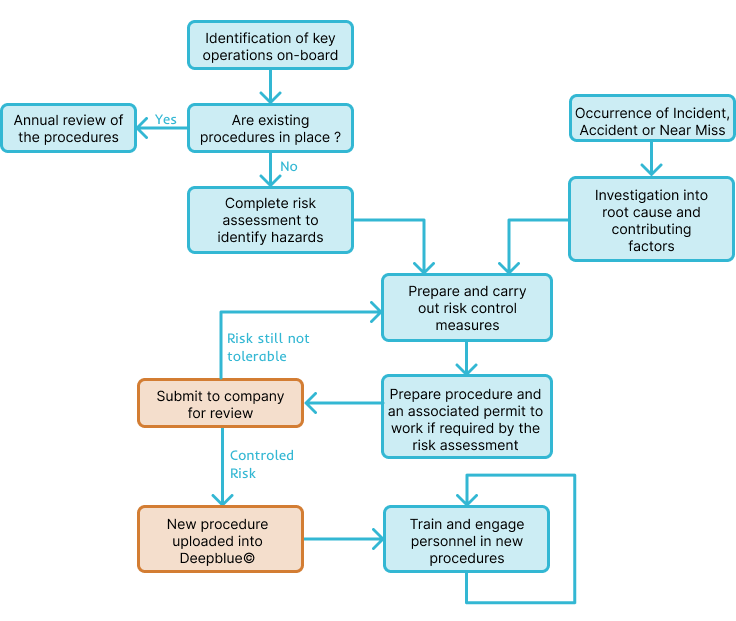
Yachting Concept Monaco has identified key operations that require risk assessments.
Safety Officer, Heads of Department, or other responsible crew (under supervision) must complete risk assessments with reference to Yachting Concept Monaco Fleet Notices and industry standards/guidance (e.g., UK Maritime and Coastguard Agency’s Code of Safe Working Practices and Flag Shipping Notices).
Key terms:
| Term | Definition |
|---|---|
| Hazard | Something with the potential to cause harm. |
| Risk | The likelihood and/or consequence of harm occurring. |
| Controls | Measures to reduce the chance of harm occurring or to reduce its effects to an acceptable level. |
- Controls may require changes in work practices, training, procedures, or SMS documentation.
- Existing yacht‑specific procedures may already embody risk assessment. If, after review, no changes are required, note this on the assessment form.
- Organise risk assessments with review dates (usually 12 months after the last assessment). Consider aligning reviews across areas (e.g., off‑season or before the Master’s Annual Review).
- Group current risk assessment records so specific tasks/areas can be located and validity/status quickly confirmed. Maintain reminders/logs of expiry dates (the Risk Assessment Library).
- Annual reviews should identify changes to equipment/physical environment, crew experience and manning, or operational areas. If no changes are required, note the review and set the next review date.
- If an incident occurs in a previously assessed area, review the relevant assessments before restarting work; include results in any accident investigation.
Risk Assessment forms are available in Deepblue© under ISM/Procedures/Safe Working Practices.
7.8.2 Reporting risk assessments
There is no requirement to report all risk assessments to Yachting Concept Monaco. If the Safety Officer or responsible person cannot reduce risk to an acceptable level (Low or Very Low), notify the Master and DPA.
7.8.3 On‑board risk assessment process
7.8.4 Permit to Work (PTW)
The following written procedures, forms, or checklists must be available, with responsibilities clearly defined:
- Permit to Work – Entry into Enclosed Spaces
- Permit to Work – Hot Work
- Permit to Work – Working aloft and over the side
- Permit to Work – Diving or in‑water operations
- Permit to Work – Machinery and equipment
- Permit to Work – Electrical
Crew Management
Safe manning, recruitment, certification, welfare, and record‑keeping requirements under the ISM Code and the Maritime Labour Convention (MLC) to ensure safe and compliant yacht operations.
Yacht Maintenance
Maintenance of the yacht, including operational routines, critical equipment, and reporting.